Mastering Cell Culture: Your Guide to Corning® Matrigel® Matrix
Whitepaper
Published: December 15, 2025
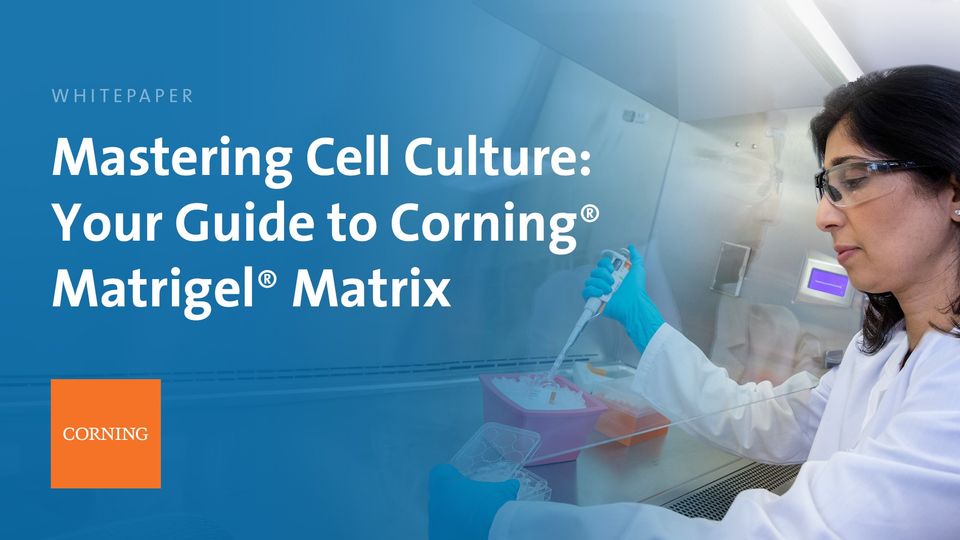
Credit: Corning.
For the past 35 years, Corning® Matrigel® matrix has been used by researchers in essential applications as well as in cutting-edge, life-changing research. CLS scientists have learned a lot over the last 3+ decades and want to share that information with the scientific community.
This ultimate guide to Corning® Matrigel® matrix features facts, tips and expert advice on the most widely used ECM in scientific research.
Download this whitepaper to access:
• 30+ helpful facts about Corning Matrigel matrix
• Top 12 tips for working with Matrigel matrix
• Do this, not that: Matrigel matrix edition
• Links to additional resources
WHITEPAPER For more than 35 years, researchers have used Corning® Matrigel® matrix for groundbreaking scientific research and discoveries. Versatile enough to accommodate emerging applications, this solution is every researcher’s indispensable and reliable tool. From essential applications to cutting-edge, life-changing research, Matrigel matrix is used today more than ever. Matrigel matrix is the most widely used extracellular matrix (ECM) in scientific research. With over 35 years of discoveries and more than 14,000 citations, this time-tested breakthrough is just getting started. This whitepaper is your ultimate guide to using Matrigel matrix, featuring facts, tips, and expert advice. It will explore new and emerging applications for using Matrigel matrix in 2D and 3D cell and tissue culture engineering, guidelines for proper handling, and best practices when using and storing. 1 Mastering Cell Culture: Your Guide to Corning Matrigel Matrix 1WHITEPAPER An Introduction to Corning® Matrigel® Matrix Over three decades ago, researchers sought to grow mouse sarcoma cells for tumor research in preclinical and translational studies. As a result of this need, Matrigel matrix was born. It has been used ever since as a scaffold for 2D and 3D cell culture models to mimic in vivo environments. Matrigel matrix is a reconstituted basement membrane extract derived from the Engelbreth-Holm-Swarm (EHS) mouse sarcoma. It contains extracellular matrix (ECM) proteins, including—when isolated—approximately 60% laminin, 30% collagen IV, and 8% entactin. This preparation also contains other ECM proteins that support cell growth and development. Proteins include heparan sulfate proteoglycan (perlecan), transforming growth factor (TGF-beta), epidermal growth factor (EGF), insulin-like growth factor (IGF-1), fibroblast growth factor (bFGF), tissue plasminogen activator, and residual matrix metalloproteinases in the EHS tumor. These constituents make Matrigel matrix beneficial for improving cell attachment and differentiation in 2D and 3D cell culture applications. 2 Mastering Cell Culture: Your Guide to Corning Matrigel MatrixWHITEPAPER How To Get the Best Use of Corning® Matrigel® Matrix Selecting the Right Matrigel Matrix Matrigel matrix is available in different formulations. Select the best one for you based on your application needs: • Standard formulation is a great choice when culturing polarized cells like epithelial cells. It also provides for the differentiation of many cell types, including smooth muscle cells, hepatocytes, and neurons. • Growth Factor Reduced (GFR) is useful for applications that benefit from a more highly defined basement membrane preparation. Applications GFR can support include cell growth and differentiation, metabolism and toxicology studies, invasion assays, in vitro and in vivo angiogenesis assays. • Matrigel matrix for organoid culture is an optimized, ready-touse Matrigel matrix version that supports organoid growth and differentiation, including those of healthy and diseased cells. Each lot is measured for its elastic modulus and formation of stable “3D domes” with media, a technique commonly used in organoid culture. With this version, researchers can bypass time-consuming screening and benefit from greater reproducibility and consistency in their organoid research. • Humanembrionicstemcells(hESC)-qualified has been certified for use with mTeSR™1 medium. Each lot is tested and confirmed to maintain hESC for five passages, and that cells remained undifferentiated by standard morphology and surface marker expression. • High Concentration (HC) has a higher protein content, between 18-22 mg/mL, significantly higher than the other options, which typically contain between 7-12 mg/mL. This formulation allows for greater matrix stiffness and scaffold integrity. HC is best for in vivo cell delivery applications as it promotes better cell engraftment and augmentation of solid tumor formation. This formulation is very viscous and opaque. • Phenol Red-free is suitable for assays that need color detection, like colorimetric assays. It is available in standard, GFR, and HC formulations. Matrigel matrix plays a crucial role in many established and emerging applications, including disease modeling, drug development, and tissue regeneration. 3 Mastering Cell Culture: Your Guide to Corning Matrigel MatrixWHITEPAPER Handling Corning® Matrigel® Matrix After deciding which formulation is best for your application, here are a few things to pay attention to when handling Matrigel matrix for your research applications. Protein Concentration The protein concentration in every lot of Matrigel matrix varies. Dilute Matrigel matrix based on protein concentration and standardized protein dilutions to ensure consistency from lot to lot. Ready to use Formats Matrigel matrix is available in several ready-to-use formats. These include Corning Matrigel matrix-3D plates for 3D cell culture applications. These plates enable ‘ontop/sandwich’ and ‘embedded’ workflows to generate spheroid and organoid cell cultures. Corning BioCoat® Matrigel matrix thin layer plates provide efficiencies for 2D studies of cellular differentiation, cell-matrix interactions, gene expression and regulation, drug screening, and sensitivity assays. Usage Matrigel matrix can be used with Corning Dispase or Corning Cell Recovery Solution to recover cells. Dispase is a proteolytic enzyme that breaks down the ECM, resulting in a single-cell suspenion. Cell Recovery Solution is a non-enzymatic solution that gently releases spheroids or organoids without breaking them up. For 3D cell culture research, you can use Matrigel matrix with the Corning spheroid microplate to aid in tight spheroid formation or to be used with media at lower concentrations as a culture supplement. It’s also suitable for use with Corning Transwell® permeable supports to perform invasion assays. Matrigel matrix requires temperature stability. Consider working with Corning CoolRack®, Corning CoolBox™ modules, and Corning ice buckets to keep cultureware and tubes cold while coating or aliquoting. Matrigel matrix quickly polymerizes when the temperature is elevated. It will start polymerizing at 10°C and rapidly gel at temperatures greater than 22°C. In frozen or thawed vials, Matrigel matrix may have color variations ranging from straw yellow to dark red. This is due to the interaction of carbon dioxide with the bicarbonate buffer and phenol red. Color variation is normal and does not affect product efficacy. It will normalize upon equilibration with 5% CO2. Matrigel matrix plug assay, often used for in vivo investigations of angiogenesis, can last up to one week in vivo. Pathogens like lactate dehydrogenase-elevating virus (LDEV) often contaminate byproducts derived from mouse tumors. When researchers use these contaminated products in studies, the contamination can compromise the accuracy and reliability of results. However, Matrigel matrix is free of these viruses because its raw materials and final products are strictly tested for a wide panel of viruses, including LDEV. Mastering Cell Culture: Your Guide to Corning Matrigel Matrix 4WHITEPAPER Corning® Matrigel® Matrix: Applications Matrigel matrix is widely used for 2D and 3D cell and tissue culture engineering. This natural ECM-based hydrogel is a popular choice for research involving normal and malignant cell types due to its many benefits, including supporting cell growth, adhesion, proliferation, and differentiation.1 Matrigel matrix provides physiologically relevant properties and cues that reflect in vivo conditions, making it essential for regulating and understanding cell functions and behaviors. Consequently, Matrigel matrix plays a crucial role in many established and emerging applications, including disease modeling, drug development, and tissue regeneration. Disease Modeling Disease modeling is an approach to understanding the biology and mechanisms of diseases—how they initiate, develop, progress, evolve, and spread. It is a fundamental step in developing safe, effective, and personalized therapies for treatment and prevention. Researchers focused on disease control pursuits can rely on Matrigel matrix in this stage of their efforts. Disease modeling relies on the reliable fabrication of 2D and 3D cell cultures, including organoids, spheroids, and tumoroids. For example, disease modeling with tumoroids can help researchers conduct more productive cancer research, investigate the physiological events that lead to cancer and enable its progression, study the tumor microenvironment, and discover cancer driver mutations.2 Matrigel matrix facilitates the generation of advanced and complex disease models for cancer, infectious diseases, and more. More specifically, it supports the engineering of 3D cell cultures that better replicate in vivo conditions in tissues, organs, and tumors. For example, researchers can now use lung and airway organoids developed with Matrigel matrix to better understand infectious diseases and respiratory conditions like COVID-19, the flu, and lung cancer. Other organoids generated with the Matrigel matrix— including gastrointestinal organoids, cerebral organoids, ovarian organoids, and prostate organoids—are critical tools for accurately modeling diseases associated with these organs, as well as for developing novel, personalized therapies for these diseases. Matrigel matrix provides physiologically relevant properties andcues that reflect in vivo conditions, making it essential for regulating and understanding cell functions and behaviors. 5 Mastering Cell Culture: Your Guide to Corning Matrigel Matrixwhitepaper 6 Mastering Cell Culture: Your Guide to Corning Matrigel® Matrix WHITEPAPER Drug Development Drug development is one of the first steps in helping patients access treatments that can extend, improve, and save their lives. But it is slow and expensive, as time-consuming and costly hurdles slow down the movement of much-needed drugs from bench to bedside. As highlighted in Nature Chemical Biology, drug development can take at least 12 years, cost up to $2.5 billion, and has a failure rate of over 90%.3 Drug development can be lengthy and resource-intensive because potential new drugs may produce adverse effects that were unaccounted for in the earlier clinical trial stages, which involved inadequate in vitro cell models. As a result, many promising drug candidates are discarded later in the clinical trial stages. This is where Matrigel matrix comes in to ward off wasted time, resources, and effort. This ECM supports the sophisticated and more realistic 3D cell culture systems required in the various development stages of personalized, safe, and effective drugs—from drug discovery to screening. For example, patient-derived organoid culture—which shows greater physiologic relevance and can be grown in Matrigel matrix —can be used to screen for drug responses and mutation-target drugs.4 Matrigel matrix has become even more critical in drug discovery and development, with the growing shift away from animal testing to more human-relevant approaches for determining drug safety before clinical trials. With the aim of phasing out animal testing in drug development, the FDA announced in April 2025 that its animal testing requirement will be reduced or replaced with organoid toxicity testing and other more predictive methods. Drug development can take at least 12 years, cost up to $2.5 billion, and has a failure rate of over 90%.3 Nature Chemical BiologyWHITEPAPER Tissue Regeneration Another application where Matrigel matrix is gaining prominence is for tissue regeneration. Here’s why: Matrigel matrix provides a biologically active scaffold that supports research and development on cell survival, proliferation, growth, migration, adhesion, and other cellular functions that promote tissue regeneration. This extends research applications of Matrigel matrix to areas such as bone regeneration, skeletal tissue regeneration, skin regeneration, and wound healing.5 One recent study published in BMC Biotechnology highlights how Matrigel matrix promotes tissue repair and is a key player in advancing stem cell therapy and tissue regeneration research.6 The study sought to explore the potential of promoting stem cell tissue regeneration therapy by loading human gingival mesenchymal stem cells (hGMSCs) with Matrigel matrix scaffolds in high-cell-density microtissues. The study found that 3D cell cultures formed with Matrigel matrix improved the stem cell function by helping maintain their stemness—which is the ability to self-renew—and supporting their growth status, viability, and adipogenic differentiation capacity. The authors note that hGMSCs combined with Matrigel matrix may support soft tissue repair and healing by activating the host microenvironment and autologous stem cells. Bioprinting Bioprinting technology brings us closer to the reality of growing viable and fully functional organs from living cells. Bioprinting, has led to breakthroughs such as the reconstruction of ovarian tissue that supports gestation, and the regeneration of damaged spinal cord axons according to research published in the International Journal of Bioprinting.7 Corning Matrigel matrix is an essential and widely used biomaterial for 3D bioprinting. It supports the engineering of structures that closely mimic the complex features of natural tissues, while also facilitating cell-cell interactions and the exchange of nutrients and gases for cellular function and survival. Research published in Biomaterials Science showed that involving bioprinting can lead to further innovations in various medical fields, particularly organ transplantations, where it shows strong promise in creating patient-compatible, living, functional organs.8 7 Mastering Cell Culture: Your Guide to Corning Matrigel Matrix 7WHITEPAPER Best Practices for Using and Handling Corning® Matrigel® Matrix Since its emergence over three decades ago, Matrigel matrix has maintained its position as the most widely used ECM for 2D and 3D cell culture research because of its reliability and versatility. Get the most out of your research efforts with these best practices for handling, storing, thawing, and diluting Matrigel matrix. Using Matrigel Matrix for Optimal Results Appropriate use of Matrigel matrix ensures the best results at every stage of your cell culture application. Regardless of your application, keep these in mind when using Matrigel matrix. • We highly recommend diluting Matrigel matrix based on protein concentration and standardized protein dilutions. • Whenever possible, use Matrigel matrix-coated plates on the day of coating. Alternatively, you can store the coated plates at 2°C to 8°C with a layer of serum-free medium. Be sure to seal the plate with parafilm and package it to maintain sterility. Since its emergence over three decades ago, Matrigel matrix has maintained its position as the most widely used ECM for 2D and 3D cell culture research because of its reliability and versatility. 8 Mastering Cell Culture: Your Guide to Corning Matrigel MatrixWHITEPAPER • Form a firm gel using more than 3 mg/mL of Matrigel matrix. For in vivo applications, do not dilute the Matrigel matrix to a final concentration below 4 mg/mL. • For assays that require color detection, it’s best to use phenol red-free products. Also, since phenol red may exhibit estrogenic effects, use Phenol Red Free Matrigel matrix if estrogenic effects are an application concern. • For any fluorescence assays, use a control experiment to determine background fluorescence since the Matrigel matrix protein components may f luoresce (excitation in the UV range), and DMEM contains substances (vitamins) that may interfere with the experiment. • When you coat a permeable support membrane, such as a Corning® Transwell® permeable support, add a drop of Matrigel matrix to the center of the insert membrane and quickly spread this volume with a pipet tip to coat the surface. CAUTION: Do not damage the membrane with the tip. • You can fix Matrigel matrix with 2% to 4% paraformaldehyde. To prevent depolymerization, add 1% glutaraldehyde to the Matrigel matrix. You can produce less background fluorescence by using less glutaraldehyde. • When using Matrigel matrix for domes for organoid assays, create sturdy domes that maintain their integrity throughout the culture’s lifespan. Increase the final Matrigel matrix concentration if domes start dissolving after several days of culture. You can stain organoids and spheroids without removing them from Matrigel matrix. However, you may need to increase the incubation times or reagent concentrations because reagents will have to diffuse through the Matrigel matrix dome to reach the cells. • Matrigel matrix provides the flexibility to select the right thickness for your applications. Thin layers of Matrigel matrix are generally recommended for cell attachment and proliferation applications. For thin gels, coat with at least 50 µL/cm2. Use thick layers of Matrigel matrix for 3D cell culture and applications (e.g., ring assay, cell invasion). For thick gels, coat with at least 150-200 µL/cm2. Mastering Cell Culture: Your Guide to Corning Matrigel Matrix 9WHITEPAPER Storing Matrigel Matrix Properly storing Matrigel matrix helps maintain its quality and keeps it ready for your next use. Do not use Matrigel matrix that is not aliquoted or stored properly. Gelling is temperature-dependent. Keep Matrigel matrix on ice at all times during handling. Avoid storing Matrigel matrix in a frost-free freezer, also known as auto defrost, which automatically melts away frost build up, without the need for manual defrosting. To minimize temperature fluctuations, do not store in a freezer door or a freezer that is opened frequently. Instead, store Matrigel matrix properly at -20°C in a non-frost-free freezer. Do not store diluted Matrigel matrix solutions, as this can cause instability. Aliquot Matrigel matrix so that you can use it once again post-thaw. Only aliquot after the first thaw and then store at -70°C or -20°C in a non-frost-free freezer using polypropylene or other compatible tubes that can withstand the cold temperature. Thawing Matrigel Matrix When thawing Matrigel matrix, do not thaw in cold water or liquefied ice, and never repeat freeze-thaw cycles of Matrigel matrix. Instead, submerge Matrigel matrix vials overnight in ice at 2°C to 8°C. Once thawed, swirl in ice to ensure the material is evenly distributed. Place the covered ice bucket towards the back of the refrigerator, where it will not be subject to temperature change. Use adequate ice so that the Matrigel matrix vial is in ice for the entire thawing process (not in cold water). Diluting Matrigel Matrix To accurately measure Matrigel matrix, it is recommended to use a positive displacement pipet (tip has a piston) or a syringe. This is important when measuring Matrigel matrix formulations, which are viscous and nontransparent. Pre-chill pipet tips and any lab equipment you plan to place in contact with Matrigel matrix. Do not use water when diluting Matrigel matrix, as it may cause aggregation. Instead, dilute by adding Matrigel matrix to an ice-cold cell culture buffer such as serum-free medium or DPBS. Mix gently by swirling or pipetting up and down. Coat vessels on ice, on a CoolRack® thermo-conductive tube module or in a CoolBox™ system. If your target protein concentration is less than 200 µg/mL, you can dilute to the final protein concentration using a serial dilution. You can modulate stiffness by controlling protein concentration. For firmer gels, use higher protein concentration. Mastering Cell Culture: Your Guide to Corning Matrigel Matrix 10WHITEPAPER Additional Corning® Matrigel® Matrix Resources and Scientific Support Choosing the right surface for your cell and cell-based assays can mean the difference between cell culture success or failure. The Corning Guide to Surface Selection by Cell Type (CLS-C-DL-AC-010), features a list of references on Matrigel matrix across a variety of cell types (e.g., primary cells, transformed/transfected cell lines, stem cell expansion and differentiation, as well as 3D cell culture applications) to help ensure you select the surface most suited to your work. To learn more about available protocols for endothelial cell tube formation, cell invasion assay, tuning the elastic moduli, hESC and 3D in vitro culture, visit www.corning.com/matrigel. For additional questions, or help troubleshooting or selecting a product, contact our experienced team of scientists and support specialists by email at ScientificSupport@corning.com or call 800-492-1110. Outside the United States, call +1-978-442-2200. Exciting breakthroughs are in store for you and Corning Matrigel matrix, from essential applications to cutting-edge, life-changing research. Visit www.corning.com/matrigel for more information. 1. Parasuraman G, et al. Matrigel-encapsulated articular cartilage derived fibronectin adhesion assay derived chondroprogenitors for enhanced chondrogenic differentiation: An in vitro evaluation. February 2025. https://www.sciencedirect.com/science/article/abs/pii/S0040816624003392 2. Kalla J, et al. A systematic review on the culture methods and applications of 3D tumoroids for cancer research and personalized medicine. May 28, 2024. https://link.springer.com/article/10.1007/s13402-024-00960-8 3. Catacutan DB, et al. Machine learning in preclinical drug discovery. Nat Chem Biol. July 19, 2024. https://www. nature.com/articles/s41589-024-01679-1 4. Jung YH, et al. Development of an extracellular matrix plate for drug screening using patient-derived tumor organoids. June 19, 2023. https://link.springer.com/article/10.1007/s13206-023-00099-y 5. Kesharwani P, et al. Tissue regeneration properties of hydrogels derived from biological macromolecules: A review. June 2024. https://www.sciencedirect.com/science/article/abs/pii/S014181302403085X 6. Xu S, et al. Activating the healing process: three-dimensional culture of stem cells in Matrigel for tissue repair. May 25, 2024. https://bmcbiotechnol.biomedcentral.com/articles/10.1186/s12896-024-00862-5 7. Mendoza-Cerezo L, et al. Evolution of bioprinting and current applications. Int J Bioprinting Vol. 9,4 742. May 2. 2023, https://pmc.ncbi.nlm.nih.gov/articles/PMC10261138/ 8. Huang G, et al. Applications, advancements, and challenges of 3D bioprinting in organ transplantation. Biomater Sci. March 2024. https://pubs.rsc.org/en/content/articlelanding/2024/bm/d3bm01934a 11 Mastering Cell Culture: Your Guide to Corning Matrigel MatrixWHITEPAPER How to Purchase: For specific availability in your region and purchasing options, terms and conditions of sale, customer/product support, and certificates, visit www.corning.com/how-to-buy. Warranty/Disclaimer: Unless otherwise specified, all products are for research use or general laboratory use only.* Not intended for use in diagnostic or therapeutic procedures. Not for use in humans. These products are not intended to mitigate the presence of microorganisms on surfaces or in the environment, where such organisms can be deleterious to humans or the environment. Corning Life Sciences makes no claims regarding the performance of these products for clinical or diagnostic applications. *For a listing of US medical devices, regulatory classifications or specific information on claims, visit www.corning.com/resources. Corning’s products are not specifically designed and tested for diagnostic testing. Many Corning products, though not specific for diagnostic testing, can be used in the workflow and preparation of the test at the customers discretion. Customers may use these products to support their claims. We cannot make any claims or statements that our products are approved for diagnostic testing either directly or indirectly. The customer is responsible for any testing, validation, and/or regulatory submissions that may be required to support the safety and efficacy of their intended application. Corning Incorporated Life Sciences www.corning.com/lifesciences NORTH AMERICA t 800.492.1110 t 978.442.2200 ASIA/PACIFIC Australia/New Zealand t 61 427286832 Chinese Mainland t 86 21 3338 4338 India t 91 124 4604000 Japan t 81 3-3586 1996 Korea t 82 2-796-9500 Singapore t 65 6572-9740 Taiwan t 886 2-2716-0338 EUROPE CSEurope@corning.com France t 0800 916 882 Germany t 0800 101 1153 The Netherlands t 020 655 79 28 United Kingdom t 0800 376 8660 The information contained within is accurate as of the date of publication and subject to change without notice. For a listing of trademarks, visit www.corning.com/trademarks. All other trademarks are the property of their respective owners. © 2025 Corning Incorporated. All rights reserved. 11/25 CLS-AC-041 All Other European Countries t +31 (0) 206 59 60 51 LATIN AMERICA grupoLA@corning.com Brazil t 55 (11) 3089-7400 Mexico t (52-81) 8158-8400
Brought to you by

Download the Whitepaper for FREE Now!
Information you provide will be shared with the sponsors for this content. Technology Networks or its sponsors may contact you to offer you content or products based on your interest in this topic. You may opt-out at any time.
Experiencing issues viewing the form? Click here to access an alternate version