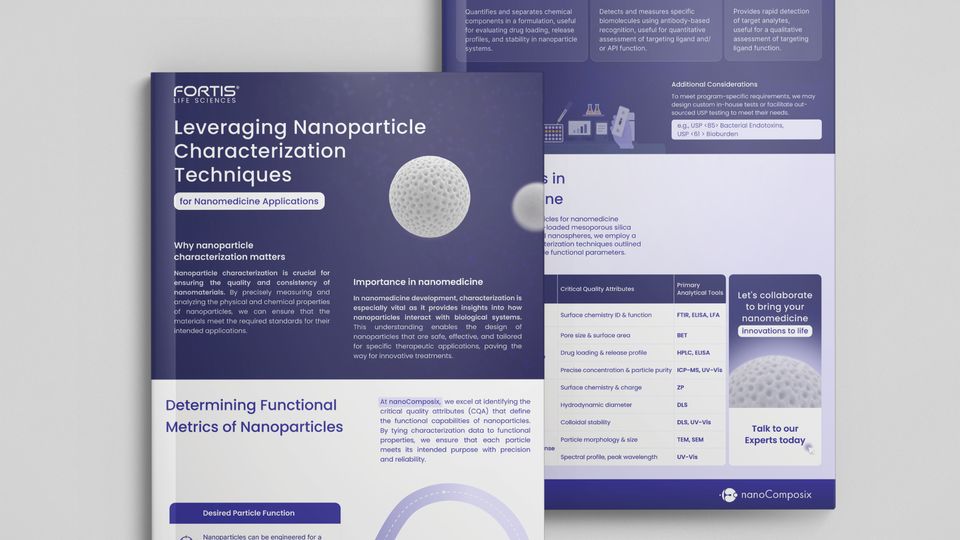
Nanoparticle characterization plays a critical role in the advancement of nanomedicine by linking structural and chemical features to therapeutic performance. With increasing demands for targeted drug delivery and biological compatibility, a deeper understanding of nanoparticle function is essential.
Developers face the challenge of ensuring particle consistency, stability and performance across varied applications. Incomplete data or poorly matched tools can result in suboptimal formulations or failed outcomes.
This infographic explores the most effective techniques for analyzing nanoparticle properties, offering guidance on selecting the right tools for measuring critical quality attributes and improving design precision.
Download this infographic to discover:
- How advanced techniques improve functional performance in nanomedicine
- Which physical and chemical attributes are most essential for particle efficacy
- When to use complementary tools for formulation validation and optimization
Leveraging Nanoparticle
Characterization
Techniques
for Nanomedicine Applications
Why Nanoparticle
characterization matters
Nanoparticle characterization is crucial for
ensuring the quality and consistency of
nanomaterials. By precisely measuring and
analyzing the physical and chemical properties
of nanoparticles, we can ensure that the
materials meet the required standards for their
intended applications.
Importance in nanomedicine
In nanomedicine development, characterization is
especially vital as it provides insights into how
nanoparticles interact with biological systems.
This understanding enables the design of
nanoparticles that are safe, effective, and tailored
for specific therapeutic applications, paving the
way for innovative treatments.
Desired Particle Function
Nanoparticles can be engineered for a
variety of functions, from targeted drug
delivery to imaging enhancement. To be
effective in their desired application,
nanoparticles require specific functional
attributes.
Complementary Checks for
Formulation Understanding
To ensure a robust formulation, cross
checks of data using different analytical
techniques are performed to confirm
experimental results, as well as identify
potential issues like instability or poor
drug release.
Critical Particle Properties
To achieve these functions,
critical properties such as size,
shape, surface charge, and
chemical composition must be
meticulously controlled.
Functional Metrics of Nanoparticles
Tools for Analyzing Function
A suite of advanced
characterization tools are used to
provide comprehensive data that
link the physical properties of
nanoparticles to their
functional performance.
At nanoComposix, we excel at identifying the
critical quality attributes (CQA) that define
the functional capabilities of nanoparticles.
By tying characterization data to functional
properties, we ensure that each particle
meets its intended purpose with precision
and reliability.
Determining Functional
Metrics of Nanoparticles
Particle Function Critical Quality Attributes Primary
Analytical Tools
Cell targeting
Analyte capture Surface chemistry ID & function FTIR, ELISA, LFA
Drug delivery
Controlled drug release
Pore size & surface area
Drug loading & release profile
Precise concentration & particle purity
BET
HPLC, ELISA
ICP MS, UV-Vis
Circulation time
Surface chemistry & charge
Hydrodynamic diameter
Colloidal stability
ZP
DLS
DLS, UV-Vis
Specific color(s)
Thermal/optical response
to light (e.g., lasers)
Particle morphology & size
Spectral profile, peak wavelength
TEM, SEM
UV-Vis
Talk to our
Experts today
Let s collaborate
to bring your
nanomedicine
innovations to life
Applications in
nanomedicine
In the development of particles for nanomedicine
applications, such as drug loaded mesoporous silica
or protein conjugated gold nanospheres, we employ a
combination of the characterization techniques outlined
above to assess key particle functional parameters.