
Modeling Tau Pathology With Human Brain Organoids
App Note / Case Study
Published: September 17, 2025
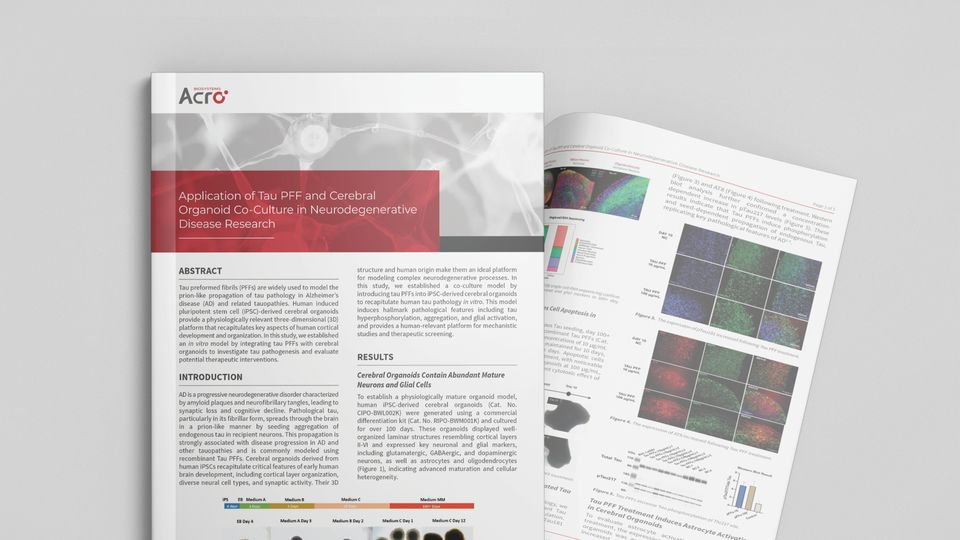
Credit: ACROBio
Tau pathology continues to be a major focus in neurodegenerative disease research. Standard 2D models often miss the complex interactions between human neural cells and the spread of pathological tau seen in Alzheimer’s and other tauopathies. These gaps in modeling accuracy have driven demand for systems that better reflect real disease mechanisms.
This application note highlights a mature 3D organoid model that combines cerebral organoids with tau preformed fibrils to support mechanistic research and therapeutic screening in a human-relevant setting.
Download this app note to explore:
- A 3D model that mimics dose-dependent tau phosphorylation and neural cell loss
- The impact of tau pathology on astrocyte activation and cytokine release
- A novel platform for studying tau seeding, neuroinflammation and therapeutic intervention strategies
Scheme 1. Schematic of the cerebral organoid di erentiation process.
ABSTRACT
INTRODUCTION
W���� P����n� �n� I�n�va�i��
A�v�n�� Bi��e�i����
techsupport@acrobiosystems.com
1 Innovation Way, Newark, DE 19711
+1 800-810-0816 (US / Canada)
+86 400-682-2521 (Asia & Pacific)
Tau preformed fibrils (PFFs) are widely used to model the
prion-like propagation of tau pathology in Alzheimer’s
disease (AD) and related tauopathies. Human induced
pluripotent stem cell (iPSC)-derived cerebral organoids
provide a physiologically relevant three-dimensional (3D)
platform that recapitulates key aspects of human cortical
development and organization. In this study, we established
an in vitro model by integrating tau PFFs with cerebral
organoids to investigate tau pathogenesis and evaluate
potential therapeutic interventions.
To establish a physiologically mature organoid model,
human iPSC-derived cerebral organoids (Cat. No.
CIPO-BWL002K) were generated using a commercial
di erentiation kit (Cat. No. RIPO-BWM001K) and cultured
for over 100 days. These organoids displayed wellorganized laminar structures resembling cortical layers
II-VI and expressed key neuronal and glial markers,
including glutamatergic, GABAergic, and dopaminergic
neurons, as well as astrocytes and oligodendrocytes
(Figure 1), indicating advanced maturation and cellular
heterogeneity.
RESULTS
AD is a progressive neurodegenerative disorder characterized
by amyloid plaques and neurofibrillary tangles, leading to
synaptic loss and cognitive decline. Pathological tau,
particularly in its fibrillar form, spreads through the brain
in a prion-like manner by seeding aggregation of
endogenous tau in recipient neurons. This propagation is
strongly associated with disease progression in AD and
other tauopathies and is commonly modeled using
recombinant Tau PFFs. Cerebral organoids derived from
human iPSCs recapitulate critical features of early human
brain development, including cortical layer organization,
diverse neural cell types, and synaptic activity. Their 3D
Cerebral Organoids Contain Abundant Mature
Neurons and Glial Cells
Application of Tau PFF and Cerebral
Organoid Co-Culture in Neurodegenerative
Disease Research
structure and human origin make them an ideal platform
for modeling complex neurodegenerative processes. In
this study, we established a co-culture model by
introducing tau PFFs into iPSC-derived cerebral organoids
to recapitulate human tau pathology in vitro. This model
induces hallmark pathological features including tau
hyperphosphorylation, aggregation, and glial activation,
and provides a human-relevant platform for mechanistic
studies and therapeutic screening.
Figure 1. (A) Immunostaining and (B) single-cell RNA sequencing confirm
robust expression of mature neuronal and glial markers in 100+ day
cerebral organoids.
Figure 2. Cell apoptosis was observed a
er 5 days of Tau PFF treatment.
Figure 3. The expression of pTau181 increased following Tau PFF treatment.
Figure 4. The expression of AT8 increased following Tau PFF treatment.
Figure 5. Tau PFFs increase Tau phosphorylation at Thr217 site.
To assess the impact of exogenous Tau seeding, day 100+
organoids were treated with recombinant Tau PFFs (Cat.
No. TAU-H5113 / TAU-H5116) at concentrations of 10 μg/mL
or 100 μg/mL. The cultures were maintained for 10 days,
with medium changes every five days. Apoptotic cells
were observed a
er 5 days of treatment, with noticeable
cellular debris surrounding the organoids at 100 μg/mL,
indicating a concentration-dependent cytotoxic e ect of
Tau PFFs (Figure 2).
To evaluate astrocyte activation following Tau PFF
treatment, the expression of GFAP and S100β in cerebral
organoids was assessed. GFAP expression significantly
increased a
er treatment, particularly at 100 μg/mL
W���� P����n� �n� I�n�va�i��
A�v�n�� Bi��e�i����
techsupport@acrobiosystems.com
1 Innovation Way, Newark, DE 19711
+1 800-810-0816 (US / Canada)
+86 400-682-2521 (Asia & Pacific)
Application of Tau PFF and Cerebral Organoid Co-Culture in Neurodegenerative Disease Research Page 2 of 5
Tau PFF Treatment Induces Cell Apoptosis in
Cerebral Organoids
To evaluate the e ect of Tau PFFs on Tau pathology, we
co-cultured cerebral organoids with recombinant Tau
PFFs and assessed phospho-Tau accumulation.
Immunostaining revealed significant increases in pTau181
Tau PFF Treatment Increases Phosphorylated Tau
Levels in a Dose-Dependent Manner Tau PFF Treatment Induces Astrocyte Activation
in Cerebral Organoids
(Figure 3) and AT8 (Figure 4) following treatment. Western
blot analysis further confirmed a concentrationdependent increase in pTau217 levels (Figure 5). These
results indicate that Tau PFFs induce phosphorylation
and seed-dependent propagation of endogenous Tau,
replicating key pathological features of AD1-5.
A
B
Figure 2. CD19 μBeads magnetically enrich for CAR T cells.
(A) The Ratio of CD3+CAR+ data is also presented in a bar chart. (B) The
enrichment fold corresponding to di erent ratios of μBeads : cells.
Figure 6. Tau PFF treatment increased GFAP expression, leading to wider
distribution and deeper penetration into the brain organoid, indicating
enhanced astrocyte activation.
Figure 7. S100β expression also increased a
er Tau PFF treatment, likely
due to astrocyte activation and potential involvement in neuroinflammatory
responses.
Figure 8. Tau PFF induces neuroinflammation and disrupts antioxidant
balance.
To investigate the neuroinflammatory and oxidative
e ects of Tau PFFs, we assessed cytokine expression and
antioxidant responses in cerebral organoids. Tau PFF
treatment upregulated pro-inflammatory cytokines IL-1β,
IL-6, and IL-8, while downregulating SOD2, a key
mitochondrial antioxidant enzyme. Elevated IL-1β may
activate NF-κB signaling in glial cells, further promoting
the release of IL-6 and IL-8. This chronic inflammatory
environment may contribute to neuronal injury and
This study establishes a robust Tau PFF-cerebral organoid
co-culture model that e ectively replicates key pathological
features of AD and related tauopathies. Exogenous Tau
PFFs e ectively seed pathology within cerebral organoids,
inducing dose-dependent hyperphosphorylation of Tau
at disease-relevant sites, including pTau181, pTau217, and
AT8. Moreover, Tau PFF exposure leads to pronounced
astrocyte activation, as evidenced by elevated expression
of GFAP and S100β. The associated pathological changes
progressively spread from the organoid surface into
deeper cortical regions, reflecting the spatial pattern of
astrocyte activation across tissue layers. Activated glia
cell may contribute to the pathological cascade by
inducing NF-κB-mediated upregulation of pro-inflammatory
cytokines such as IL-1β, IL-6, and IL-8, leading to chronic
neuroinflammation and increased neuronal vulnerability.
The downregulation of the mitochondrial antioxidant
enzyme SOD2 further cause ROS accumulation and
mitochondrial dysfunction, forming a vicious cycle
between inflammation and oxidative stress that
exacerbates neuronal damage and apoptosis.
Human-derived organoids bridge the gap between
traditional 2D in vitro systems and animal models,
providing a pathologically relevant platform for studying
Tau aggregation and propagation, neuroinflammationoxidative stress interactions, and glia-neuron crosstalk. It
also enables therapeutic screening for compounds
targeting Tau seeding, inflammatory pathways (e.g., IL-1
β/NF-κB), or mitochondrial redox imbalance (e.g., SOD2
CONCLUSION
Tau PFF Treatment Induces Neuroinflammation
and Impairs Antioxidant Defenses in Cerebral
Organoids
RESULTS
CAR-T Cell Enrichment
W���� P����n� �n� I�n�va�i��
A�v�n�� Bi��e�i����
techsupport@acrobiosystems.com
1 Innovation Way, Newark, DE 19711
+1 800-810-0816 (US / Canada)
+86 400-682-2521 (Asia & Pacific)
Application of Tau PFF and Cerebral Organoid Co-Culture in Neurodegenerative Disease Research Page 3 of 5
(Figure 6), with signals extending from the organoid
surface into deeper layers, indicating reactive
astrocytosis. S100β, a CNS-specific astrocyte marker, also
showed elevated expression and deeper tissue
penetration at 100 μg/mL (Figure 7). These findings
suggest that high-dose Tau PFFs may induce pronounced
astrocyte activation and early neuroinflammatory
responses in cerebral organoids5-6.
enhanced oxidative stress through glia-derived reactive
oxygen species (ROS). The downregulation of SOD2 may
further impair mitochondrial function by allowing the
accumulation of superoxide radicals7-9.
Human Tau-441 K18 Pre-formed Fibrils Protein, Tag Free
(Cat. No. TAU-H5116)
Human Tau-441 K18 (P301L) Pre-formed Fibrils Protein,
Tag Free (Cat. No. TAU-H5113)
Ready-to-use Human iPSC-Derived Mature Cerebral
Organoids 100 days+ (Cat. No. CIPO-BWL002K)
Human iPSC-Derived Cerebral Organoid Di erentiation
Kit (Cat. No. RIPO-BWM001K)
Human iPSC-Derived Cerebral Organoid Maturation and
Maintenance Kit (Cat. No. RIPO-BWM003)
METHODS AND MATERIALS
Samples and Reagents
Tau PFFs were prepared by incubating recombinant
human Tau monomers at 37°C under constant agitation
for 7 days to promote fibrillization. Fibril formation was
validated by Thioflavin T (ThT) fluorescence assay and
transmission electron microscopy (TEM). The resulting
PFFs were aliquoted and stored at −80°C. Prior to use,
PFFs were briefly sonicated to generate shorter fragments
suitable for cellular uptake. The sonicated PFFs were then
diluted to final working concentrations of 10 μg/mL or 100
μg/mL in cerebral organoid culture medium. Media were
exchanged every five days, and treatment was
maintained for 10 days.
PFFs Preparation
Total RNA was isolated using the FastPure Cell/Tissue
TotalRNA lsolation Kit V2, and template complementary
DNA was prepared by reverse transcription using the
HiScript lll RT SuperMix for qPCR(+gDNA wiper) (Vazyme).
qPCR was performed with the Tag Pro Universal
SYBRqPCR Master Mix (Vazyme).
Real-time quantitative polymerase chain
reaction (RT-qPCR)
Single-cell RNA sequencing was outsourced by a
third-party provider.
Single-cell RNA Sequencing
Cerebral organoids were fixed with 4% paraformaldehyde,
cryoprotected in 30% sucrose, and sectioned using a
cryostat. Sections were permeabilized, blocked, and
incubated with primary antibodies overnight at 4°C. A
er
washing, fluorescent secondary antibodies were applied
for 2 hours at room temperature. Nuclei were counterstained
with DAPI, and slides were mounted using ProLong™ Gold
Antifade Mountant. Imaging was performed on a Zeiss
Axio Observer Apotome microscope.
For protein quantification, organoids were lysed in RIPA
bu er supplemented with protease and phosphatase
inhibitors. Protein expression levels of total Tau and
phosphorylated Tau (pTau217) were assessed using the
Simple Western Jess system (ProteinSimple, Bio-Techne).
Sample separation, immunodetection, and chemiluminescent
signal acquisition were performed according to the
manufacturer’s protocol. GAPDH was used as a loading
control. Signal intensities were analyzed and normalized
Immunofluorescence Staining and Simple
Western Analysis
W���� P����n� �n� I�n�va�i��
A�v�n�� Bi��e�i����
techsupport@acrobiosystems.com
1 Innovation Way, Newark, DE 19711
+1 800-810-0816 (US / Canada)
+86 400-682-2521 (Asia & Pacific)
Application of Tau PFF and Cerebral Organoid Co-Culture in Neurodegenerative Disease Research Page 4 of 5
modulators). Overall, this system o ers a powerful tool
for mechanistic research and translational studies in
neurodegenerative diseases.
using Compass for Simple Western so
ware (Bio-Techne).
W���� P����n� �n� I�n�va�i��
A�v�n�� Bi��e�i����
techsupport@acrobiosystems.com
1 Innovation Way, Newark, DE 19711
+1 800-810-0816 (US / Canada)
+86 400-682-2521 (Asia & Pacific)
Application of Tau PFF and Cerebral Organoid Co-Culture in Neurodegenerative Disease Research Page 5 of 5
References
[1] Rawat P, Sehar U, Bisht J, Selman A, Culberson J, Reddy PH. Phosphorylated Tau in Alzheimer's Disease and Other Tauopathies. Int J Mol Sci.
2022;23(21):12841. doi:10.3390/ijms232112841
[2] Kaufman SK, Sanders DW, Thomas TL, et al. Tau Prion Strains Dictate Patterns of Cell Pathology, Progression Rate, and Regional Vulnerability
In Vivo. Neuron. 2016;92(4):796-812. doi:10.1016/j.neuron.2016.09.055
[3] Sanders DW, Kaufman SK, DeVos SL, et al. Distinct tau prion strains propagate in cells and mice and define di erent tauopathies. Neuron.
2014;82(6):1271-1288. doi:10.1016/j.neuron.2014.04.047
[4] Liu F, Huang J, Zhang L, et al. Advances in Cerebral Organoid Systems and their Application in Disease Modeling. Neuroscience. 2019;399:28-38.
doi:10.1016/j.neuroscience.2018.12.013
[5] Vogel JW, Iturria-Medina Y, Strandberg OT, et al. Spread of pathological tau proteins through communicating neurons in human Alzheimer's
disease [published correction appears in Nat Commun. 2021 Aug 5;12(1):4862. doi: 10.1038/s41467-021-25193-3.]. Nat Commun. 2020;11(1):2612.
Published 2020 May 26. doi:10.1038/s41467-020-15701-2
[6] Michetti F, Clementi ME, Di Liddo R, et al. The S100B Protein: A Multifaceted Pathogenic Factor More Than a Biomarker. Int J Mol Sci. 2023;24
(11):9605. Published 2023 May 31. doi:10.3390/ijms24119605
[7] Kummer KK, Zeidler M, Kalpachidou T, Kress M. Role of IL-6 in the regulation of neuronal development, survival and function. Cytokine.
2021;144:155582. doi:10.1016/j.cyto.2021.155582
[8] Vilotić A, Nacka-Aleksić M, Pirković A, Bojić-Trbojević Ž, Dekanski D, Jovanović Krivokuća M. IL-6 and IL-8: An Overview of Their Roles in Healthy
and Pathological Pregnancies. Int J Mol Sci. 2022;23(23):14574. Published 2022 Nov 23. doi:10.3390/ijms232314574
[9] Flynn JM, Melov S. SOD2 in mitochondrial dysfunction and neurodegeneration. Free Radic Biol Med. 2013;62:4-12.
doi:10.1016/j.freeradbiomed.2013.05.027
About ACROBiosystems
ACROBiosystems Group, founded in 2010 and listed in 2021, is a biotechnology company
aimed at becoming a cornerstone of the global biopharmaceutical industry by providing life
science tools and business model innovation. ACROBiosystems spans across the globe and
maintains over twelve o ices, research & development centers, and production bases across
the United States, Europe, and Asia. Numerous partnerships with well-known enterprises
such as Pfizer, Novartis, and other academic institutes have been established. Through the
continuous development of new technologies and tools, ACROBiosystems is dedicated
towards helping their customers overcome challenges from drug discovery to
commercialization through innovative life science tools and solutions.
Brought to you by

Download the Application Note for FREE Now!
Information you provide will be shared with the sponsors for this content. Technology Networks or its sponsors may contact you to offer you content or products based on your interest in this topic. You may opt-out at any time.
Experiencing issues viewing the form? Click here to access an alternate version

