Middle-Down Proteomics: Bridging Bottom-Up and Top-Down
Advances in middle-down proteomics enable comprehensive analysis of intact proteoforms.
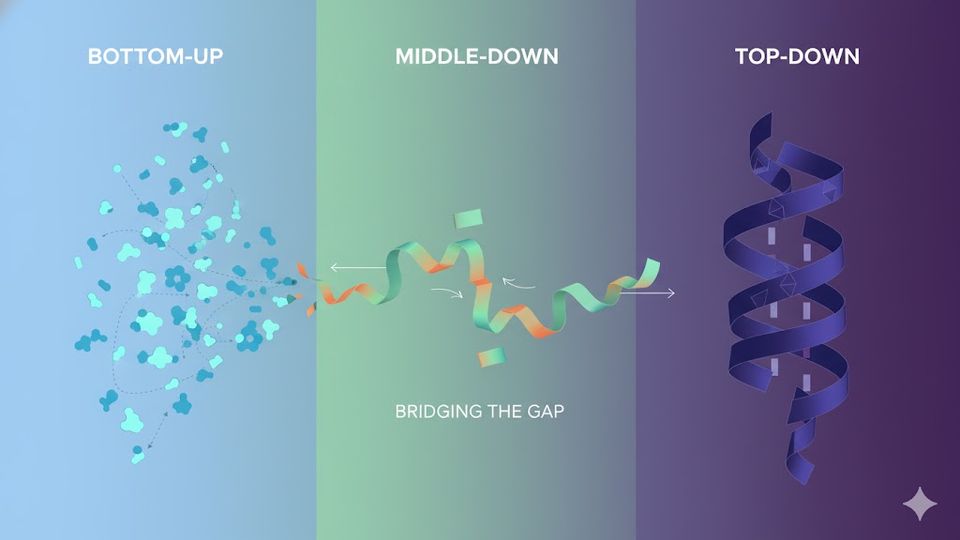
The field of proteomics has historically been split into bottom-up and top-down methodologies. Each method presents inherent trade-offs in coverage, throughput, and the preservation of protein structural context. Recent advancements in instrumentation are driving the emergence of middle-down proteomics. This technique offers a crucial compromise, addressing critical gaps in large-scale protein characterization. It is rapidly being adopted in advanced proteomics workflows to provide a more complete understanding of the proteome. The technique involves the controlled, partial cleavage of intact proteins into large peptide fragments, which are optimally sized for analysis by high-resolution mass spectrometry.
The conventional bottom-up strategy relies on exhaustive tryptic digestion, offering unparalleled proteome coverage and throughput. However, fragmenting proteins into small peptides (typically less than
The rationale for middle-down proteomics
The primary rationale for middle-down proteomics is the need for high-confidence proteoform analysis that is also scalable. A proteoform is defined by its full complement of modifications and sequence variations; these factors dictate its function and localization. Bottom-up approaches cannot provide this level of detail. When two PTMs are identified on separate tryptic peptides, even from the same protein, there is no information on whether they coexist on a single protein molecule or are mutually exclusive.
Middle-down strategies effectively circumvent this problem. They generate large peptide fragments, typically ranging from
Compared to top-down analysis, middle-down proteomics also handles protein complexity more effectively. The technique reduces the overall mass range and simplifies the sample mixture. This simplification, which involves generating a limited number of defined large peptides instead of thousands of small ones, significantly enhances the efficiency and confidence of chromatographic separation and mass spectral detection.
Sample preparation and limited proteolysis strategies
The success of middle-down proteomics hinges on precise control over the partial proteolysis step. Unlike bottom-up approaches that aim for exhaustive digestion, middle-down workflows require finely tuned enzymes. These enzymes must cleave at a limited number of sites, consistently generating the desired large peptide fragments.
The choice of enzyme and reaction conditions is paramount. While trypsin remains the gold standard for bottom-up analysis, less specific or highly controllable enzymes are preferred in middle-down strategies:
Enzymes for Controlled Digestion: Enzymes like Lys-C, Lys-N, Asp-N, and Glu-C are often employed due to their restricted cleavage sites, resulting in larger, more manageable fragments. Chymotrypsin, while having broader specificity, can be used effectively when reaction time and enzyme concentration are meticulously controlled.
Non-Enzymatic Methods: Chemical cleavage methods, such as cyanogen bromide (CNBr) treatment (which cleaves at methionine residues), can also be used to generate predictable large peptide fragments, especially in targeted workflows.
Sample Cleanup: Given the larger size and potentially higher hydrophobicity of these fragments, standard C18 solid-phase extraction (SPE) commonly used in bottom-up protocols must be optimized. Specialized columns and phases designed for larger analytes are often necessary to ensure efficient cleanup and minimal loss of the target large peptide fragments prior to mass spectrometry.
The resulting large peptide fragments are then subjected to high-performance separation, typically using nano- or microflow liquid chromatography before introduction into the mass spectrometer.
Mass spectrometry techniques in middle-down workflows
The analysis of the intermediate-sized peptides generated by middle-down proteomics requires robust separation and high-resolution mass spectrometry. The field relies heavily on advanced LC-MS/MS proteomics instruments, particularly those featuring high mass accuracy and versatile fragmentation capabilities.
Table 1. Comparative features of proteomic workflows.
| Feature | Bottom-Up Proteomics | Middle-Down Proteomics | Top-Down Proteomics |
| Analyte Size | <3kDa (Small Tryptic Peptides) | 3kDa–20 kDa (Large Peptide Fragments) | >20 kDa (Intact Proteins) |
| Proteoform Information | Lost (PTMs unlinked) | Retained (PTM Clusters preserved) | Fully Retained (Complete connectivity) |
| Throughput | High (Industry Standard) | Medium to High (Scalable) | Low (Technically demanding) |
| PTM Localization | Challenging/Ambiguous | High-Confidence Localization | High-Confidence Localization |
| Sample Complexity | Highly Complex Mixture | Reduced Complexity | Lowest Complexity (Few species) |
For MS analysis, advanced high-resolution mass spectrometers are favored. Their combination of ultra-high mass resolution and sensitivity is crucial for accurately determining the charge state and mass of larger, multiply-charged ions. The fragmentation of these large peptide fragments presents a unique challenge, requiring activation methods more energetic or complementary than collision-induced dissociation (CID), which is commonly used for smaller tryptic peptides.
Advanced fragmentation techniques are key to success in middle-down proteomics for achieving high-coverage sequence information:
Electron Capture Dissociation (ECD) and Electron Transfer Dissociation (ETD): These electron-based methods are non-ergodic and particularly effective for fragmenting multiply-charged, larger peptides while minimizing the loss of labile PTMs, which is critical for proteoform analysis.
High-Energy Collision Dissociation (HCD) and EThcD: HCD provides highly specific fragmentation, and the combination of ETD with HCD (EThcD) offers complementary sequence information, significantly increasing confidence in PTM assignment and protein identification within the proteomics workflows.
The combination of controlled proteolysis and complementary fragmentation strategies enables the precise mapping of modifications and structural changes, yielding a deeper insight into the functionality of the proteome than either bottom-up or top-down approaches can achieve alone.
Advancing proteoform analysis in translational research
The utility of middle-down proteomics is particularly evident in translational research, where the precise characterization of biologically active proteoforms is paramount for drug development and biomarker discovery.

Advances in Proteomics & Metabolomics 2026
This event will explore advances in analytical tools, data integration and applications that are expanding what’s possible in systems biology and precision research.View Online Event
One of the most significant applications is in the study of recombinant protein therapeutics, such as monoclonal antibodies (mAbs). mAbs are complex glycoproteins that can be subject to numerous modifications during bioproduction, including glycosylation, oxidation, and deamidation. Analyzing the intact mAb (top-down) can be prohibitively complex, but bottom-up analysis destroys the linkage information. Middle-down proteomics allows the mAb to be cleaved into two or three large fragments (e.g., F(ab')2, Fc/2) that retain the PTM clusters (such as the heavy chain glycosylation site) but simplify the mass spectra. This facilitates rapid, high-throughput quality control and structural characterization in biopharmaceutical proteomics workflows.
Furthermore, in cancer research, the approach is ideal for investigating core histone modifications. Histone proteins are heavily decorated with PTMs that regulate gene expression. A single histone tail can bear multiple acetylation, methylation, and phosphorylation marks. By using specialized enzymes to cleave the histone protein into a single, modified tail fragment (a large peptide fragment), middle-down proteomics enables the simultaneous identification of the entire combinatorial pattern of PTMs present on that single molecule. This level of detail is essential for understanding the epigenetic code, which is frequently dysregulated in malignancy.
Overall, the ability of middle-down proteomics to provide linked PTM information on large peptides—a capability often cited as the key advantage of middle-down vs top-down analysis in a high-throughput context—is driving new discoveries in diseases where PTM heterogeneity is a defining feature, ultimately pushing the boundaries of functional proteomics workflows.
Future outlook and research implications
The evolution of middle-down proteomics methodologies continues to reshape the landscape of protein characterization. The immediate future is focused on further integration and automation. Automation of the limited proteolysis and sample preparation steps is critical to elevating the throughput from high-end research applications to routine, large-scale clinical studies. The development of specialized robotic platforms and microfluidic devices designed to handle the critical timing and reagent delivery required for controlled cleavage will be necessary for wide adoption in clinical proteomics workflows.
Furthermore, computational advancements are essential for handling the intricate data generated from the large peptide fragments. Software must evolve to accurately deconvolve complex, multiply-charged mass spectra and efficiently map PTMs onto these extensive sequences, distinguishing between true proteoforms and fragmentation artifacts.
The long-term implication of middle-down vs top-down and bottom-up comparisons is that middle-down proteomics is emerging as a promising foundational approach for systematic proteoform analysis. By successfully bridging the analytical gap between protein coverage and structural integrity, middle-down proteomics enables a new class of high-resolution, biologically-relevant data acquisition, ultimately linking technology development to novel and precise mechanistic insights in laboratory and research settings.
This content includes text that has been created with the assistance of generative AI and has undergone editorial review before publishing. Technology Networks’ AI policy can be found here.