We've updated our Privacy Policy to make it clearer how we use your personal data. We use cookies to provide you with a better experience. You can read our Cookie Policy here.
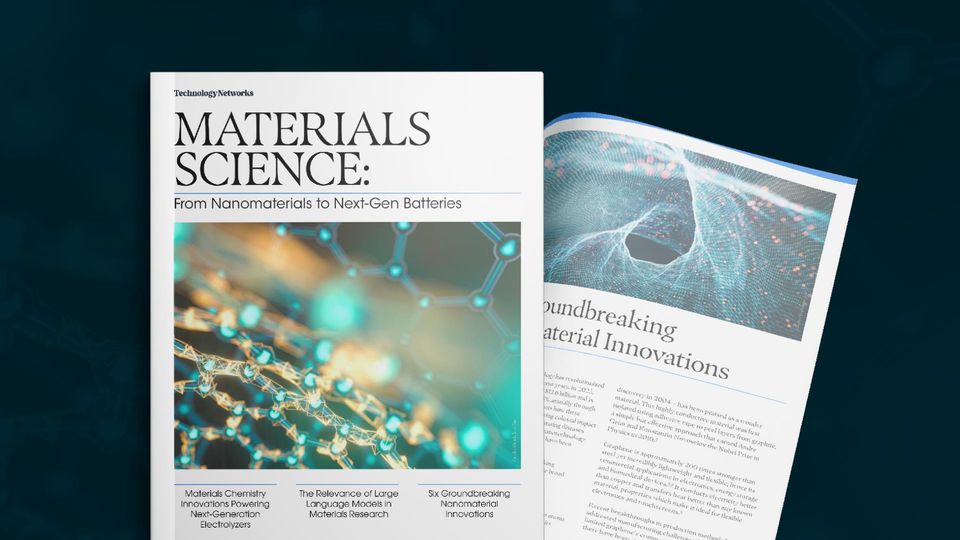
Materials Science: From Nanomaterials to Next-Gen Batteries
eBook
Published: December 10, 2025
Credit: Technology Networks.
Across energy, health and sustainability sectors, materials science is fueling breakthroughs. As demand for efficiency, resilience and safety grow, the limitations of conventional materials are driving the development of new innovations.
This eBook explores advances in battery materials, nanotechnology, electrolyzers, biomaterials and AI tools, showcasing how chemistry, engineering and data science converge to accelerate discovery and application across diverse domains.
Download the eBook to discover:
How next-gen materials and structures drive energy storage breakthroughs
The role of biomaterials and nanostructures in reshaping health research
How AI and digital twins are transforming materials innovation
MATERIALS SCIENCE:
From Nanomaterials to Next-Gen Batteries
Advancements in materials science, particularly focusing on innovations in battery technologies, nanomaterials, and their applications in energy storage and healthcare.
Battery Materials and Technologies Powering the Future
Rechargeable batteries are essential for modern technology, driving the need for more efficient and faster-charging solutions.
Rechargeable batteries power devices from smartphones to electric vehicles (EVs).
Consumer demand for faster charging and longer battery life is increasing.
Limitations of conventional lithium-ion (Li-ion) batteries include slow charging times and limited cycle life.
Research focuses on novel materials, improved designs, and innovative chemistries to enhance battery performance.
Emerging Materials Enhance Charging Efficiency
New materials are being explored to improve battery performance, particularly silicon-based anodes.
Silicon can store up to 10 times more lithium ions than graphite, increasing energy density.
Challenges include silicon's expansion during charging, leading to degradation.
Researchers are stabilizing silicon using advanced materials like graphene.
Solid-state electrolytes offer a safer alternative to liquid electrolytes, enhancing thermal stability and ionic conductivity.
Innovative Structural Designs for Batteries
Structural innovations are crucial for improving battery charging times and longevity.
3D electrode architectures increase surface area for ion exchange, accelerating charging.
Optimized cathodes made from nickel, cobalt, and manganese enhance energy capacity and stability.
Nanomaterials are used for electrode coatings and separators, improving efficiency and durability.
Transitioning to Next-Generation Battery Technologies
Next-generation battery technologies are emerging to address the limitations of Li-ion batteries.
Solid-state batteries (SSBs) and sodium-ion (Na-ion) batteries are promising alternatives.
SSBs replace liquid electrolytes with solid ones, enhancing safety and energy density.
Na-ion batteries are suitable for large-scale storage due to sodium's abundance and lower cost.
Innovations in solvation architecture and electrode engineering are key for fast charging and long cycle life.
The Outlook for Battery Science
The future of battery science is focused on transformative breakthroughs in energy storage.
Innovations in materials and structural designs are revolutionizing battery performance.
Emerging technologies like SSBs and Na-ion batteries hold significant promise.
Continued research is essential for developing efficient, reliable, and sustainable battery technologies.
Advances in Alkaline Water Electrolysis
Alkaline water electrolysis is a mature technology facing challenges that researchers are addressing through innovative materials and designs.
Alkaline water electrolysis uses cheaper transition metal catalysts like nickel due to its alkaline conditions.
Challenges include lower current densities, electrode corrosion, and gas permeation issues.
Guo et al. developed cobalt-cerium MOFs as electrodes, reducing energy consumption and projected hydrogen costs to meet DOE targets.
Initial durability studies showed a stability of 5,000 hours, needing further improvement to reach 90,000 hours for commercial viability.
Innovations in Selectively Permeable Membranes
Membrane technology is crucial for improving the efficiency and purity of hydrogen production in electrolyzers.
Membranes prevent gas mixing while allowing ion transport, balancing conductivity and gas purity.
Abdel Haleem et al. created a two-faced membrane with distinct properties, enhancing ionic conductivity and reducing gas permeation by a factor of three.
This innovation improves gas purity in electrolyzer systems, although it does not completely eliminate gas crossover.
Proton Exchange Membrane Water Electrolysis
Proton exchange membrane (PEM) electrolysis addresses the limitations of alkaline systems but requires expensive precious metal catalysts.
PEM systems use a solid polymer film to separate anode and cathode, allowing proton passage while blocking electrons and gases.
The oxygen evolution reaction is the rate-limiting step, necessitating high catalyst loadings of iridium or ruthenium oxides.
Dong et al. developed a gradient-loaded anode with ten times less iridium, increasing active area and reducing efficiency losses by up to 48%.
Alternatives to Precious Metal Catalysts
Research is ongoing to find cost-effective alternatives to precious metals in hydrogen evolution reactions.
Molybdenum sulfides have shown potential as catalysts, with active sites located at the edges of clusters.
Gonell et al. designed amorphous surfaces that enhance activity across a larger area, improving hydrogen evolution reactivity.
Development of Anion Exchange Membrane Electrolysis
Anion exchange membrane systems are emerging as a promising alternative to existing electrolysis technologies.
These systems utilize non-noble metal catalysis and high current density, but face challenges in membrane stability under alkaline conditions.
Cross-linking techniques have been explored to enhance the durability of membranes, as demonstrated by Wu et al. using chitin biowaste to create a crosslinked nanochannel membrane.
Future Projections for Hydrogen Production
The global electrolyzer capacity is expected to grow significantly, driven by technological advancements and material innovations.
It is estimated that electrolyzer capacity will reach 520 gigawatts by 2030, a 700-fold increase from 2023.
Reducing upfront and operational costs remains a critical challenge for widespread adoption of electrolysis technologies.
Overview of Battery Recycling Techniques
Battery recycling involves several methods to recover valuable materials from used batteries.
Three main methods include hydrometallurgy, pyrometallurgy, and direct recycling.
Each method involves preprocessing, separation, and regeneration of materials to produce new batteries.
Groundbreaking Innovations in Nanomaterials
Nanotechnology is revolutionizing various fields, with significant advancements in materials science.
The nanomaterials market reached $12.6 billion in 2023, projected to grow at 15% annually through 2030.
Innovations include graphene, quantum dots, nanoparticle drug delivery systems, and metamaterials with engineered optical properties.
The Role of Large Language Models in Materials Research
Large language models (LLMs) are transforming materials science by automating data extraction and supporting hypothesis generation.
LLMs can extract knowledge from vast scientific literature, improving efficiency in research workflows.
Applications include automated data extraction, property prediction, materials design, and research ideation.
Graphene Foam for Osteoarthritis Treatment
Graphene foam is being explored as a bioscaffold for lab-grown cartilage to treat osteoarthritis.
The study found that electrical stimulation of progenitor cells on graphene foam increased mechanical strength and cell interconnectivity.
Understanding the impact of electrical stimulus on cell signaling could lead to patient-specific cartilage implants.
Techniques for Operando Battery Analysis
Operando techniques are essential for understanding battery performance under real operating conditions.
Differential electrochemical mass spectrometry (DEMS) and Fourier transform infrared spectroscopy (FTIR) are key methods for analyzing battery chemistry.
Combining various techniques can provide a comprehensive understanding of battery processes, aiding in the development of better materials and technologies.
Sponsored by
Download the eBook for FREE Now!
Information you provide will be shared with the sponsors for this content. Technology Networks or its sponsors may contact you to offer you content or products based on your interest in this topic. You may opt-out at any time.