Mapping Microglia To Unlock New Paths in Neuroscience
A new, large-scale Microglia Map is redefining what’s possible in neuroscience drug discovery.
Unraveling the biology of the brain remains one of the toughest challenges in drug discovery, especially for conditions such as Alzheimer’s, amyotrophic lateral sclerosis (ALS) and other neurodegenerative diseases, where traditional targets have yielded limited progress.
A new large-scale effort aims to change that by creating an unprecedented, data-rich view of microglial biology – one capable of revealing entirely new therapeutic entry points.
To understand how this work is reshaping the landscape of neuroscience research, Technology Networks spoke with Dr. Najat Khan, incoming CEO and president, and current chief research and development officer, chief commercial officer and board member at Recursion, who shared insights into the creation of the Microglia Map and what it could mean for future drug discovery.
Could you start by explaining what makes this map such a groundbreaking achievement for neuroscience drug discovery?
Najat Khan, PhD (NK):
Neurological conditions remain the primary cause of illness and disability worldwide, but it is incredibly difficult to understand and treat diseases of the brain like Alzheimer’s and ALS – the underlying biology is simply not well understood due to the brain’s complexity. As a result, companies tend to focus on a few well-known targets.
The Microglia Map allows Roche and Recursion to move beyond conventional targets by providing an unbiased, holistic view of the entire network of biology. By performing a whole-genome screen on >17,000 genes, it enables researchers to look at the unexplored biology around the known “bright spots,” driving the discovery of completely novel genes and pathways for first-in-class therapies.

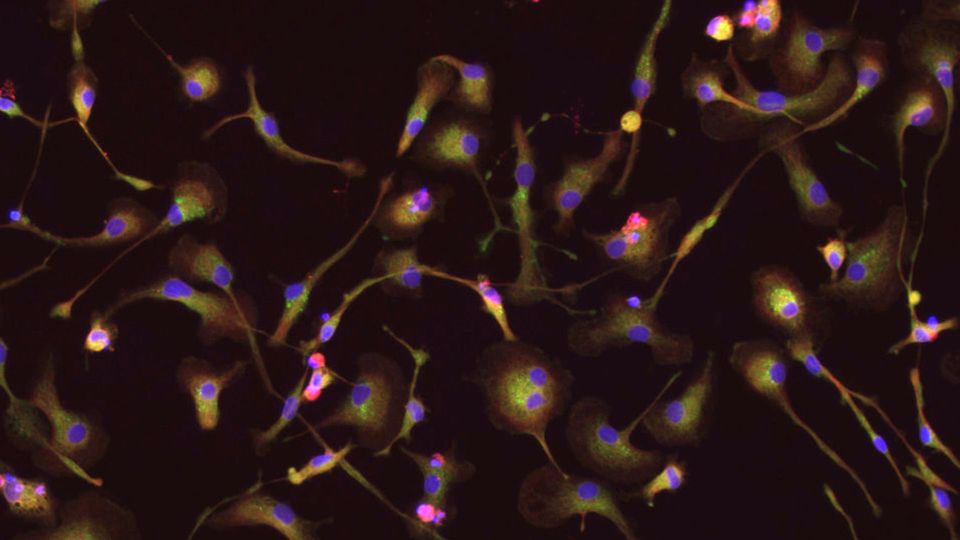
Microglial
cells using Brightfield microscopy, microglial cells using Cell Paint, and
iPSCs, the precursors to microglial cells. Credit: Recursion.
IE:
What motivated Recursion to focus on microglial cells, and how do they contribute to understanding neurological disease mechanisms?
NK:
Microglia are the resident immune cells of the brain, and there is growing evidence linking microglial dysfunction to chronic inflammation and tissue damage across the nervous system. Microglial activation is thought to play a role in Alzheimer’s, Parkinson’s, ALS, dementia, palsy and Huntington’s disease.
By observing the relationship between thousands of genes and chemical compounds on microglial morphology and function (their phenotypic readout), we gain a foundational understanding of the causal role of genes in core microglial biology and anticipate making discoveries with implications for treating a wide range of neuroinflammatory and neurodegenerative diseases.
IE:
The scale of this project is vast – over 100 billion hiPSC-derived microglia and 46 million images. What challenges did your team face in generating and analyzing such vast datasets?
NK:
The team had to develop and scale new cell manufacturing techniques in order to produce enough microglia for the map, and to produce them in a standardized way, something that had never been done before. Although human induced pluripotent stem cells (hiPSCs) can be differentiated to become any cell type, microglia can be highly variable from batch to batch – and are very sensitive to their environment, changing states from relatively stable to becoming more reactive and inflammatory. The team successfully confirmed that the microglia we started with were as stable as possible, which allowed us to reliably compare all the map perturbations against one another.

The making of the Microglia Map. Credit: Recursion.
IE:
You’ve mentioned that several biological insights have already emerged from this collaboration. Could you share examples of potential targets or pathways that have been identified so far?
NK:
Our first whole-genome phenotypic map in neuroscience, developed as part of this partnership and delivered last year – called the NeuroMap – has already led our partners Roche and Genentech to identify a number of biological insights that could become novel targets of interest. We cannot provide any further specifics, but we’re very excited by the positive early signals.
IE:
Finally, if we were to revisit this conversation five years from now, what milestones would you hope Recursion has achieved in neuroscience drug discovery?
NK:
There’s a massive need for new targets and new therapies in neurodegenerative diseases and I believe these maps will serve as an important starting place for significantly expanding those opportunities.
In five years, I would predict that we would see a number of the initial promising signals from our maps being pursued as drug discovery programs, and I think it’s likely we will have built or expanded other cell-specific maps as we continue to zero in on areas of interest and incorporate additional data types like single cell screens and transcriptomics data.