We've updated our Privacy Policy to make it clearer how we use your personal data. We use cookies to provide you with a better experience. You can read our Cookie Policy here.
Steven has a BSc in Pharmacology and a Masters in Bioscience from the University of Leeds, as well as a Ph.D. in Pharmacy from the University of Nottingham. After finishing his Ph.D. he spent two years working at an agency as a medical writer. Wanting to further develop his communication skills he joined Technology Networks as a science writer in 2023. In his current role, he is responsible for creating custom written content and also contributes to the development of digital content.
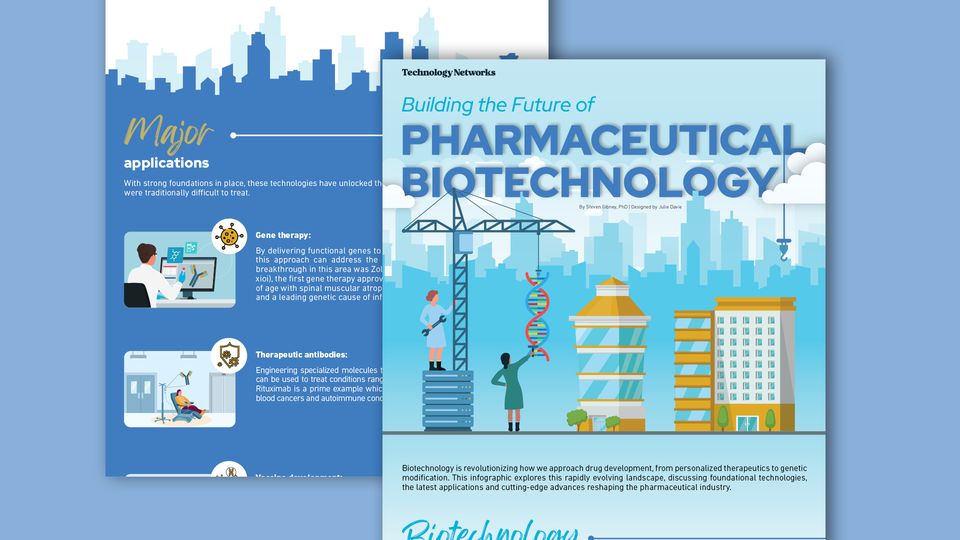
The pharmaceutical industry is experiencing a transformative shift as biotechnology innovations unlock new possibilities for treating previously intractable diseases.
However, navigating this rapidly evolving landscape presents significant challenges for researchers and pharmaceutical professionals seeking to stay current and competitive.
This infographic provides a guide to the core biotechnological foundations driving modern drug development and their breakthrough applications.
Download this infographic to discover:
The foundational biotechnology platforms enabling modern pharmaceutical innovation
Major therapeutic applications transforming patient care
Advances in AI-driven drug discovery that are accelerating development timelines
Building the Future of
Biotechnology is revolutionizing how we approach drug development, from personalized therapeutics to genetic
modification. This infographic explores this rapidly evolving landscape, discussing foundational technologies,
the latest applications and cutting-edge advances reshaping the pharmaceutical industry.
The development of pharmaceutical products relies on the latest technological developments. Just as any structure
requires solid foundations, innovations in biotechnology support the entire industry.
Biotechnology
is the foundation of
drug development
Major
applications
With strong foundations in place, these technologies have unlocked therapeutic approaches for diseases that
were traditionally difficult to treat.
Recombinant DNA technology
This cornerstone of modern
biotechnology provides a means to
combine DNA from different sources
to create novel therapeutic proteins
and peptides.
Cell-free protein synthesis:
It is now possible to bypass
traditional cell-based manufacturing
by directly producing therapeutic
proteins, accelerating development
timelines. In particular, cell-free
platforms can produce antibody–
drug conjugates in hours rather
than weeks.6
Gene therapy:
By delivering functional genes to replace or supplement defective ones,
this approach can address the root causes of inherited disorders. A
breakthrough in this area was Zolgensma (onasemnogene abeparvovecxioi),
the first gene therapy approved to treat children less than two years
of age with spinal muscular atrophy (SMA), the most severe form of SMA
and a leading genetic cause of infant mortality.3
Vaccine development:
By training the immune system to recognize and combat pathogens,
vaccines can be used to prevent the spread of deadly pathogens. This
was fundamental in the development of the mRNA COVID vaccines.5
Therapeutic antibodies:
Engineering specialized molecules that recognize and bind to specific targets
can be used to treat conditions ranging from cancer to autoimmune diseases.
Rituximab is a prime example which has revolutionized treatment for certain
blood cancers and autoimmune conditions like rheumatoid arthritis.4
Cell culture systems
These systems allow the growth of
cells outside their natural environment,
providing controlled conditions for
producing biologics at scale. This
includes the use of CHO cells for
antibody production.1
Monoclonal antibody
production
It is now possible to develop
highly specific antibodies that
target disease mechanisms
with unprecedented precision.
Gene editing tools
CRISPR-Cas9 and similar
technologies enable targeted
modifications to correct genetic
defects, such as those in sickle
cell disease.2
Vaccine
AI-driven drug discovery:
Artificial intelligence can be used to
identify potential drug candidates
and optimize molecular structures,
dramatically reducing research time
and costs. DeepMind’s AlphaFold
has revolutionized protein structure
prediction, providing crucial insights
for drug development.8
Precision medicine:
Tailoring treatments to individual
genetic profiles ensures each
therapeutic intervention is
designed for maximum efficacy
with minimal side effects. A key
example is the treatment of breast
cancer using Herceptin in HER2-
positive patients.7
Pharmaceutical biotechnology continues
to construct the future of medicine,
engineering the tools needed to deliver
cutting-edge treatments to a wider range
of patients.
References
1. Kunert R, Reinhart D. Advances in recombinant antibody manufacturing. Appl Microbiol Biotechnol. 2016;100:3451–3461. doi: 10.1007/s00253-
016-7388-9
2. FDA Approves First Gene Therapies to Treat Patients with Sickle Cell Disease. U.S. Food and Drug Administration. www.fda.gov/news-events/
press-announcements/fda-approves-first-gene-therapies-treat-patients-sickle-cell-disease. Published December 8, 2023. Accessed August
8, 2025.
3. FDA approves innovative gene therapy to treat pediatric patients with spinal muscular atrophy, a rare disease and leading genetic cause
of infant mortality. U.S. Food and Drug Administration. www.fda.gov/news-events/press-announcements/fda-approves-innovative-genetherapy-
treat-pediatric-patients-spinal-muscular-atrophy-rare-disease Published May 24, 2019. Accessed August 8, 2025
4. Mok CC. Rituximab for the treatment of rheumatoid arthritis: an update. Drug Des Devel Ther. 2013;8:87–100. doi: 10.2147/dddt.s41645
5. Decades in the Making: mRNA COVID-19 Vaccines. National Institute of Allergy and Infectious Diseases. www.niaid.nih.gov. www.niaid.nih.gov/
diseases-conditions/decades-making-mrna-covid-19-vaccines. Published April 4, 2024. Accessed August 8, 2025
6. Hunt AC, Vögeli B, Hassan AO, et al. A rapid cell-free expression and screening platform for antibody discovery. Nat Commun. 2023;14:3897.
doi: 10.1038/s41467-023-38965-w
7. Goutsouliak K, Veeraraghavan J, Sethunath V, et al. Towards personalized treatment for early stage HER2-positive breast cancer. Nat Rev Clin
Oncol. 2019;17(4):233–250. doi: 10.1038/s41571-019-0299-9
8. Varadi M, Bertoni D, Magana P, et al. AlphaFold Protein Structure Database in 2024: providing structure coverage for over 214 million protein
sequences. Nucleic Acids Res. 2023;52(D1):368–375. doi: 10.1093/nar/gkad1011
Latest
advances
By Steven Gibney, PhD | Designed by Julie Davie
Sponsored by
Download the Infographic for FREE Now!
Information you provide will be shared with the sponsors for this content. Technology Networks or its sponsors may contact you to offer you content or products based on your interest in this topic. You may opt-out at any time.