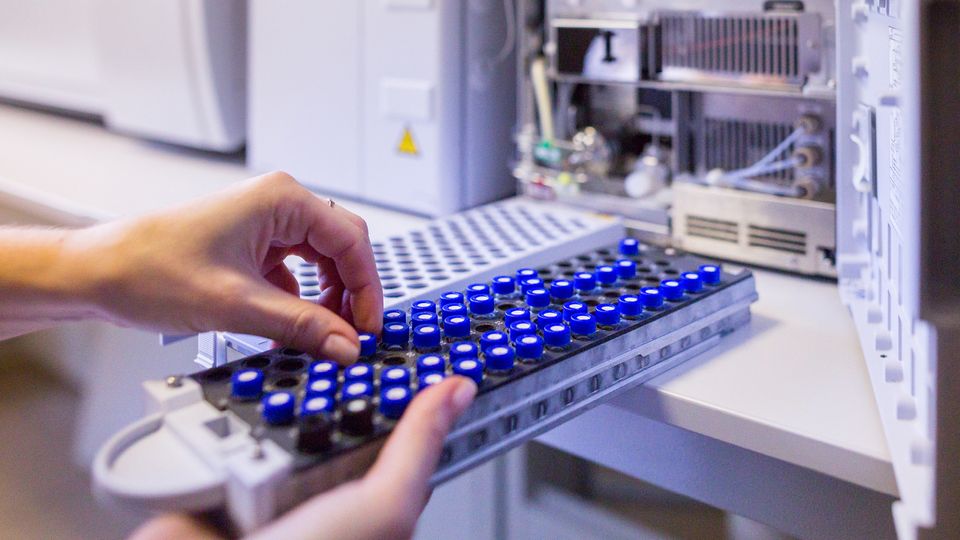
GLP-1 receptor agonists – including Ozempic (semaglutide) and Mounjaro (tirzepatide) – are peptide therapeutics used to manage type 2 diabetes and obesity by helping regulate glucose levels and promote weight loss.
As peptide-based therapeutics evolve in structural complexity, comprehensive analytical characterization becomes indispensable to confirm identity, purity and critical quality attributes that underpin safety and efficacy.
This eBook offers an overview of analytical workflows for GLP-1 receptor agonists, highlighting the central role of liquid chromatography and mass spectrometry. It brings together LC/MS-based workflows that support every stage of peptide assessment, providing a complete view of how to evaluate these therapeutics with confidence.
Download this eBook to discover:
- The unique advantages of peptide therapeutics
- The sensitive methods needed to determine critical quality attributes
- Analytical solutions for every step from impurity assessment to bioanalysis studies
Agilent biopharma solutions
Complete Analytical Workflows
for GLP-1 Receptor Agonists
Applications for peptide characterization, purification, and bioanalysis
Introduction 03
1 Identity, Purity, and Impurity Assessment 06
1.1 Introduction 06
1.2 Molecular Weight Confirmation of a Peptide Using MS Spectral
Deconvolution for OpenLab CDS and the Agilent InfinityLab LC/MSD
XT System 08
1.3 An In-Depth Analysis of Semaglutide, a Glucagon-Like Peptide-1
Receptor Agonist 14
1.4 Quantification of Glucagon-Like Peptide-1 Agonist tirzepatide
Using an Agilent 6495D Triple Quadrupole LC/MS System 22
2 Impurity Analysis 28
2.1 Confirmation of Peptide-Related Impurity Intact Mass Using Agilent
1290 Infinity II Bio 2D-LC and InfinityLab LC/MSD XT 28
2.2 Characterization of Forced Degradation Impurities of
Glucagon‑Like Peptide-1 Agonists by LC/Q-TOF Mass Spectrometry 40
3 Sequence Confirmation 49
3.1 LC/MS Based Characterization Workflow of GLP-1 Therapeutic
Peptide Liraglutide and Its Impurities 49
3.2 Identification of Amino Acid Isomers Using Electron Capture
Dissociation in the Agilent 6545XT AdvanceBio 4 Purification Solutions 67
4.1 Introduction 67
4.2 Workflow Ordering Guide: Analysis and Purification
of Synthetic Peptides by Liquid Chromatography 68
4.3 Optimizing Analysis and Purification of a Synthetic Peptide
Using PLRP-S Columns 76
4.4 Efficient Purification of Synthetic Peptides at High and Low pH 84
5 Bioanalysis Studies 93
5.1 Introduction 93
5.2 Quantification of Therapeutic Peptide Exenatide in Rat Plasma 94
Introduction
Peptides occupy a unique space between small molecules and biologics, offering distinct and
tunable pharmacokinetic (PK) and pharmacodynamic (PD) profiles for therapeutic applications.
They generally have a lower risk of triggering immune reactions compared to biologics such as
monoclonal antibodies, are less expensive to produce, and penetrate tissues more effectively
due to their smaller size. Although most peptides do not easily cross cell membranes, advances
in engineering have improved intracellular targeting and cellular uptake. Compared to small
molecules, peptides often demonstrate higher specificity and selectivity, reducing unwanted
side effects. Because peptides degrade into naturally occurring amino acids, they are less likely
to accumulate in tissues or cause long-term toxicity. Their size and flexibility allow them to
modulate large protein surfaces and protein-protein interactions (PPIs).
Manufacturing peptides is more straightforward and costeffective
than producing proteins or antibodies, allowing for high
purity and consistent quality. Additionally, peptides are often
more stable in storage and may not require refrigeration, cutting
down on logistical challenges and costs.
Recent innovations in drug design, including methods to extend
peptide half-life (like acylation, PEGylation, or fusion to larger
proteins), alongside advances in delivery platforms, have
significantly accelerated the development of next-generation
peptide therapeutics. These improvements address common
issues of rapid breakdown and clearance, which traditionally
required frequent injections. New peptide-based therapies have
also expanded into areas like targeted delivery and vaccines.
Despite these advances, the increasing complexity of peptide
drugs—due to varied molecular structures, conjugation strategies,
and delivery formats—poses challenges for quality control.
Peptides work through diverse mechanisms—acting as receptor
agonists or antagonists, enzyme inhibitors, immune modulators,
or disrupting intracellular signaling. They are used to treat a broad
range of conditions, including metabolic and cardiovascular
diseases, cancer, and infectious diseases.
Manufacturing peptides is more straightforward and costeffective
than producing proteins or antibodies, allowing for high
purity and consistent quality. Additionally, peptides are often
more stable in storage and may not require refrigeration, cutting
down on logistical challenges and costs.
Recent innovations in drug design, including methods to extend
peptide half-life (like acylation, PEGylation, or fusion to larger
proteins), alongside advances in delivery platforms, have
significantly accelerated the development of next-generation
peptide therapeutics. These improvements address common
issues of rapid breakdown and clearance, which traditionally
required frequent injections. New peptide-based therapies have
also expanded into areas like targeted delivery and vaccines.
Despite these advances, the increasing complexity of peptide
drugs—due to varied molecular structures, conjugation strategies,
and delivery formats—poses challenges for quality control.
Peptides work through diverse mechanisms—acting as receptor
agonists or antagonists, enzyme inhibitors, immune modulators,
or disrupting intracellular signaling. They are used to treat a broad
range of conditions, including metabolic and cardiovascular
diseases, cancer, and infectious diseases.
Figure 1. (a) Timeline of relevant milestones in the development of therapeutic peptides (only selected classes of FDA-approved drugs from 2000
onwards), (b) Classification of the FDA-approved molecules (from 1940 until October 2024) and their respective clinical use, (c) Distribution of peptidebased
drugs and in-vivo diagnostics approval times from 2000 to 2024, compiled from the freely available database PepTherDia [7], with insulin-based
drug data sourced from [8].
Analysis of peptide therapeutics
As the complexity and diversity of peptide-based products continue to grow, the importance of robust analytical capabilities becomes
increasingly evident. Sensitive and selective methods are essential for determining and monitoring critical quality attributes (CQAs), such
as identity, content, purity, and impurities, to ensure the quality, safety, and efficacy of these therapeutics (Table 1). The challenge extends
to the bioanalysis of these modalities, including PK and PD assessments in biological matrices. Liquid chromatography (LC) and mass
spectrometry (MS) play a central role in supporting the above measurements.
5 Return to Contents Section
Applications Goal Approach
Identity
Ensuring that the peptide has the correct structure which is,
primarily, defined by the amino acid sequence and intended
modifications (lipidation, amidation, PEGylation, etc.)
- Comparison of retention time to reference standard by LC/UV
- Molecular mass determination by LC/MS
- Sequence determination by LC/MS/MS
- Amino acid analysis by LC/FLD
Purity and impurity
Assessing the proportion of the desired peptide relative to
impurities (purity) and detecting, identifying and quantifying
process- (solvents, reagents, metals, host-cell materials, etc.)
and product-related impurities (impurity)
- Purity and product-related impurities: LC/UV, LC/MS,
LC/MS/MS, 2D-LC
- Process-related impurities: LC/UV, LC/ELSD, LC/RI, LC/MS,
LC/MS/MS, GC/FID, GC/MS, ICPMS
Content Determination of the absolute quantity of the therapeutic
peptide
- LC/UV, LC/MS, LC/MS/MS using external or internal
calibration
- Amino acid analysis by LC/FLD
Bioanalysis (PK/PD) Quantification of therapeutic peptides in biological matrices
(blood, plasma, serum, urine, …)
- 1D or 2D-LC/MS/MS with tailored sample preparation and
absolute quantification using isotopically labeled synthetic
peptides or analogue peptides
Table 1. Therapeutic peptide attributes studied by LC and MS.
This compendium brings together practical insights and application notes focused on analytical challenges and method development for
GLP-1 receptor agonists and related peptides. It is designed to support scientists involved in ensuring the quality and reliability of these
innovative therapeutics as they continue to transform patient care.
With content adapted from contributions by RIC Group.
References
1. A.J. Pereira, L.J. de Campos, H. Xing, M. Conda-Sheridan,
Peptide-based therapeutics: challenges and solutions,
Medicinal Chemistry Research 33 (2024) 1275–1280.
https://doi.org/10.1007/s00044-024-03269-1.
2. W. Xiao, W. Jiang, Z. Chen, Y. Huang, J. Mao, W. Zheng, Y.
Hu, J. Shi, Advance in peptide-based drug development:
delivery platforms, therapeutics and vaccines, Signal
Transduct Target Ther 10 (2025). https://doi.org/10.1038/
s41392-024-02107-5.
3. M. Yu, M.M. Benjamin, S. Srinivasan, E.E. Morin, E.I.
Shishatskaya, S.P. Schwendeman, A. Schwendeman,
Battle of GLP-1 delivery technologies, Adv Drug Deliv
Rev 130 (2018) 113–130. https://doi.org/10.1016/j.
addr.2018.07.009.
4. K. Fosgerau, T. Hoffmann, Peptide therapeutics: current
status and future directions, Drug Discov Today 20 (2015)
122–8. https://doi.org/10.1016/development.
5. G. Rossino, E. Marchese, G. Galli, F. Verde, M. Finizio, M.
Serra, P. Linciano, S. Collina, Peptides as Therapeutic
Agents: Challenges and Opportunities in the Green
Transition Era, Molecules 28(20) (2023) 7165. https://doi.
org/10.3390/molecules28207165.
6. K. Jones, Tools and Techniques for GLP-1 Analysis, LCGC
International (2025). https://www.chromatographyonline.
com/view/tools-and-techniques-for-glp-1-analysis.
7. PepTherDia: Database of Peptide Therapeutics and
Diagnostics. https://peptherdia.herokuapp.com/ (accessed
July 2, 2025).
8. G. Walsh, E. Walsh, Biopharmaceutical benchmarks
2022, Nat Biotechnol 40 (2022) 1722–1760. https://doi.
org/10.1038/s41587-022-01582-x.
9. L. Wang, N. Wang, W. Zhang, X. Cheng, Z. Yan, G. Shao,
X. Wang, R. Wang, C. Fu, Therapeutic peptides: current
applications and future directions, Signal Transduct Target
Ther 7(1) (2022) 48. https://doi.org/10.1038/s41392-022-
00904-4.
10. M. D’Hondt, N. Bracke, L. Taevernier, B. Gevaert, F. Verbeke,
E. Wynendaele, B. De Spiegeleer, Related impurities in
peptide medicines, J Pharm Biomed Anal 101 (2014) 2–30.
https://doi.org/10.1016/j.jpba.2014.06.012.
11. FDA, 100 Years of Insulin, (2022). https://www.fda.gov/
about-fda/fda-history-exhibits/100-years-insulin (accessed
July 8, 2025).
12. D. Yi, J.E. Mertz, Paul Berg and the origins of recombinant
DNA, Cell 187 (2024) 1019–1023. https://doi.org/10.1016/j.
cell.2024.01.007.
13. CHMP, EMA. Assessment report Ozempic, 2021. https://
www.ema.europa.eu/en/documents/variation-report/
ozempic-h-c-004174-x-0021-epar-assessment-reportvariation_
en.pdf (accessed July 8, 2025).
14. O. Al Musaimi, Unlocking the Potential of Retro-Inverso (RI)
Peptides as Future Drug Candidates, Int J Pept Res Ther
30 (2024) 56. https://doi.org/10.1007/s10989-024-10639-1.
15. C.A. Rhodes, D. Pei, Bicyclic Peptides as Next-Generation
Therapeutics, Chemistry - A European Journal 23 (2017)
12690–12703. https://doi.org/10.1002/chem.201702117.
16. R.A. Bottens, T. Yamada, Cell-Penetrating Peptides
(CPPs) as Therapeutic and Diagnostic Agents for Cancer,
Cancers (Basel) 14 (2022). https://doi.org/10.3390/
cancers14225546.
17. P. Thongpon, M. Tang, Z. Cong, Peptide-Based Nanoparticle
for Tumor Therapy, Biomedicines 13 (2025).
Abstract
Peptide biotherapeutics represent a class of pharmaceuticals that hold
significant importance in modern medicine due to their unique properties and
diverse therapeutic applications. Peptides are short chains of amino acids,
typically comprising fewer than 50 residues, and they play crucial roles in
various physiological processes within the human body. With advancements
in biotechnology and pharmaceutical research, the development and use of
peptide‑based therapeutics have surged, offering novel treatment options for
a wide range of medical conditions. This application note presents some of the
challenges when analyzing a glucagon-like peptide-1 (GLP-1) receptor agonist,
semaglutide acetate, comparing different gradient conditions, temperatures, and
column chemistries. Furthermore, sequence identification was achieved by LC/MS
analysis using an Agilent AdvanceBio Peptide Plus column.