AI-Enabled Imaging Solutions for Complex 3D Organoid Screening
App Note / Case Study
Published: November 6, 2025
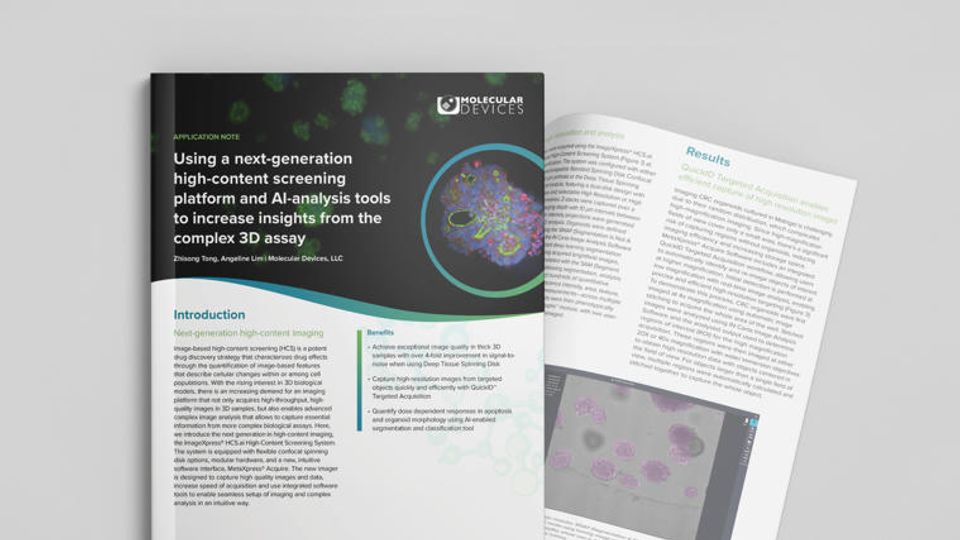
Credit: Molecular Devices
Modern drug discovery increasingly relies on patient-derived organoid models that closely mimic human biology, yet imaging these complex 3D structures presents significant technical challenges.
Traditional high-content screening systems often struggle with thick sample penetration, inefficient targeting of randomly distributed organoids and the computational demands of analyzing intricate morphological changes across treatment conditions.
This application note demonstrates how next-generation confocal imaging technology combined with AI-powered analysis tools enables researchers to capture high-quality images from 3D organoids.
Download this app note to discover:
- How advanced spinning disk confocal technology improves signal-to-noise ratio for deep tissue imaging of 3D organoid models
- How intelligent targeted acquisition workflows automatically identify and re-image objects of interest
- How AI-enabled segmentation and machine learning tools rapidly quantify complex phenotypic responses
moleculardevices.com | © 2025 Molecular Devices, LLC. All rights reserved.
APPLICATION NOTE
Using a next-generation
high-content screening
platform and AI-analysis tools
to increase insights from the
complex 3D assay
Zhisong Tong, Angeline Lim | Molecular Devices, LLC
Benefits
• Achieve exceptional image quality in thick 3D
samples with over 4-fold improvement in signal-tonoise
when using Deep Tissue Spinning Disk
• Capture high-resolution images from targeted
objects quickly and efficiently with QuickID™
Targeted Acquisition
• Quantify dose dependent responses in apoptosis
and organoid morphology using AI-enabled
segmentation and classification tool
Introduction
Next-generation high-content imaging
Image-based high-content screening (HCS) is a potent
drug discovery strategy that characterizes drug effects
through the quantification of image-based features
that describe cellular changes within or among cell
populations. With the rising interest in 3D biological
models, there is an increasing demand for an imaging
platform that not only acquires high-throughput, highquality
images in 3D samples, but also enables advanced
complex image analysis that allows to capture essential
information from more complex biological assays. Here,
we introduce the next generation in high-content imaging,
the ImageXpress® HCS.ai High-Content Screening System.
The system is equipped with flexible confocal spinning
disk options, modular hardware, and a new, intuitive
software interface, MetaXpress® Acquire. The new imager
is designed to capture high quality images and data,
increase speed of acquisition and use integrated software
tools to enable seamless setup of imaging and complex
analysis in an intuitive way.
moleculardevices.com | © 2025 Molecular Devices, LLC. All rights reserved.
Drug efficacy and toxicity testing often rely on immortalized
cell lines or animal models that don’t closely mimic
complex human biology. This can lead to inaccurate
predictions of a drug’s potential and extended drug
development timelines. However, retrospective studies
confirm a high degree of similarity between the phenotype
and genotype of a patient-derived organoids (PDO) and
an original patient tumor. In this application, we cultured
patient-derived colorectal cancer (CRC) organoids
embedded in an extracellular matrix (ECM) layer and show
dose-dependent effect in organoid morphology and cell
viability after treatment with anti-cancer drugs. We show
use of QuickID™ Targeted Acquisition and Deep Tissue
Confocal Spinning Disk as an acquisition tool to obtain
high resolution images of 3D structures. The images were
analyzed using a user-trained deep learning segmentation
model in IN Carta® image analysis software to generate
multiparametric data to quantify phenotypic effects
of compounds.
Overall, the ImageXpress HCS.ai system renders fast,
high-throughput acquisition and high-quality images
using an intuitive software interface. These combined
improvements to acquisition speed, image quality, and
machine learning-assisted analysis enable the use of
more assays and models for both research and 3D
drug screening.
Methods
Cell culture and staining
Colorectal 3D Ready™ Organoids (Molecular Devices)
were used for phenotypic evaluation of compound
effects. Organoids were provided in cryopreserved vials,
then thawed, and seeded into IBIDI 96 well plates (Ibidi)
as organoid domes mixed with 80% Matrigel (Corning
Life Sciences), 15 μl per well. Organoids were cultured
in a base media (DMEM/F12 with Glutamax, HEPES,
Pen/strep) supplemented with N2, B27 and N-acetyl
cysteine according to recommended protocol (Thermo
Fisher Scientific). Rock inhibitor was used in the media
to aid in recovery of organoids, after which the media
was replaced with supplemented base media without
rock inhibitor. After 48 hours, organoids were treated
with selected compounds for 5 days. Organoids were
dosed with the following compounds, in 4-fold dilution
series, in triplicates. Concentrations were used as
following 5-Fluorouracil (5FU, 1000 μM), Chloroquine
(100 μM), Trametinib (100 μM). Doxorubicin (100 μM)
was used as positive controls. All reagents were from
Sigma LifeSciences.
After treatment, MitoTracker reagent (Thermo Fisher
Scientific) was added to the media overnight, following
which they were fixed with 4% formaldehyde (Sigma
LifeSciences) and after that stained with Alexa Flour 488
Phalloidin (1:200) and Hoechst 33342 (1:500) nuclear dye
in the presence of 0.1% of Triton X (Sigma LifeSciences).
Figure 1. ImageXpress HCS.ai High-Content Screening System.
moleculardevices.com | © 2025 Molecular Devices, LLC. All rights reserved.
Image acquisition and analysis
Images were acquired using the ImageXpress® HCS.ai
Advanced High-Content Screening System (Figure 1) at
10X magnification. The system was configured with either
the user-exchangeable Standard Spinning Disk Confocal
module (60 μm pinhole) or the Deep Tissue Spinning
Disk Confocal module, featuring a dual-disk design with
50 μm pinholes and selectable High Resolution or High
Sensitivity geometries. Z-stacks were captured over a
200 μm total imaging depth with 10 μm intervals between
planes. Maximum intensity projections were generated
for subsequent 2D analysis. Organoids were defined
and segmented using the SINAP (Segmentation Is Not A
Problem) module in the IN Carta Image Analysis Software
(Figure 2). A customized deep learning segmentation
model was trained using acquired brightfield images,
which were rapidly annotated with the SAM (Segment
Anything Model) tool. Following segmentation, analysis
was conducted to extract hundreds of quantitative
features—including fluorescence intensity, area, texture,
and other morphological measurements—across multiple
imaging channels. Organoids were then phenotypically
classified using the Phenoglyphs™ module, with two userdefined
classes: intact and damaged.
Results
QuickID Targeted Acquisition enables
efficient capture of high resolution images
Imaging CRC organoids cultured in Matrigel is challenging
due to their random distribution, which complicates
high-magnification imaging. Since high-magnification
fields of view cover only a small area, there’s a significant
risk of capturing regions without organoids, reducing
imaging efficiency and increasing storage space.
MetaXpress® Acquire Software includes an integrated
QuickID Targeted Acquisition workflow, allowing users
to automatically identify and re-image objects of interest
at higher magnification. Initial detection is performed at
low magnification with real-time image analysis, enabling
precise and efficient high-resolution targeting (Figure 3).
To demonstrate this process, CRC organoids were first
imaged at 4x magnification using automatic image
stitching to acquire the whole area of the well. Stitched
images were analyzed using IN Carta Image Analysis
Software and the analyzed output used to determine
regions of interest (ROI) for the high magnification
acquisition. These regions were then imaged at either
20X or 40x magnification with water immersion objectives
to obtain high resolution data with objects centered in
the field of view. For objects larger than a single field of
view, multiple regions were automatically calculated and
stitched together to capture the whole object.
Figure 2. IN Carta Image Analysis Software includes two major modules: SINAP (Segmentation Is Not A Problem) is a deep learning based image
segmentation module that allows users to customize their own model using training image sets, equipped with SAM (Segment Anything Model) tool;
Phenoglyphs is a machine learning based customizable data classifier, whose user-in-the-loop training mode allows users to visually annotate the object
based on its phenotype and reassign misclassified objects in the training.
moleculardevices.com | © 2025 Molecular Devices, LLC. All rights reserved.
Figure 3. A. QuickID workflow: low-magnification preview scan to capture the objects, followed by analysis to determine the regions of interest, then
high-magnification acquisition used to capture high-resolution image or targeted objects. B. CRC organoids were imaged with QuickID with 4X objective,
followed by IN Carta analysis to identify organoids using simple thresholding in the DAPI channel. Next, the 20X objective was used to acquire highresolution
images. C. The 40X objective was used to acquire high-resolution images using the same sample as in Figure 3B.
moleculardevices.com | © 2025 Molecular Devices, LLC. All rights reserved.
Deep Tissue Disk ensures high
signal-to-noise ratio
An additional challenge in 3D organoid imaging stems
from the increased sample thickness, which reduces the
signal-to-noise ratio at deeper imaging planes. Spinning
disk confocal imaging provides high speed of image
acquisition but conventional systems can be limiting due
to the fixed pinhole sizes and fixed spacing geometry.
The ImageXpress HCS.ai System features AgileOptix™
spinning disk confocal technology which allows users
to swap between different spinning disks and optimize
for acquisition speed and imaging quality. The Standard
Confocal Spinning Disk uses a 60 μm pinhole and is a
versatile all-round option suitable for a variety of assays.
The optional Deep Tissue Confocal Spinning Disk utilizes
a smaller 50 μm pinhole size with a two disk configuration,
software controlled switching, and offers two geometries
optimized for High Sensitivity (HS) and High Resolution
(HR) image which are optimized for higher magnification
objectives and minimize pinhole crosstalk with thicker 3D
samples. Here, we demonstrate improved image quality
obtained with the Deep Tissue Disk compared to the
Standard Disk when imaging through a cross section of
a CRC organoid (Figure 4). Quantitation of the line scan
shows an average signal-to-noise ratio (SNR) improvement
of 4.5 in the image acquired with Deep Tissue Disk.
A B
Figure 4. A. CRC image acquired with 50um pinhole deep tissue disk; B. CRC image acquired with 60um pinhole confocal disk; C. Signal to noise ratio
analysis in the line scan measurement shown in Figure 4A and 4B.
C
Signal to Noise Ratio
Signal to noise ratio of line scan
— Standard Confocal Disk (60 μm pinhole) — Deep Tissue Disk (50 μm pinhole, High Resolution)
moleculardevices.com | © 2025 Molecular Devices, LLC. All rights reserved.
3D Ready Organoids were used to demonstrate an
“off-the-shelf” solution to screen a physiologically
relevant, patient-derived organoid model with a high
assay consistency. Organoids were seeded on the liquid
handling deck of the CellXpress.ai Automated Cell Culture
System. The seeded organoids were first treated with
compounds (5FU, Chloroquine and Trametinib), then
stained, fixed and imaged using the ImageXpress HCS.ai
System with Standard Confocal Optics with 60um pinhole
size (Figure 5A).
Figure 5. A. Representative image of the CRC organoids treated with 5FU, Chloroquine, Trametinib and control, respectively; B. One-click SAM tool
showing the accurate segmentation of the organoid; C. Example segmentation masks of organoids of various sizes generated using a customized AI
model within the SINAP module, shown with magenta outlines.
moleculardevices.com | © 2025 Molecular Devices, LLC. All rights reserved.
F-actin can be found at cell-cell contact sites and is
important for maintaining cell adhesion. CRCs from the
untreated control group exhibited a ring F-actin surround
the lumen, as shown by phalloidin staining. However, 5FU
treated organoids do not show the distinct phalloidin ring
suggesting that 5FU disrupted organoid organization.
This was further supported by the observation that these
organoids have fewer cells, as shown by decreased DAPI
staining. Trametinib treated organoids were smaller than
untreated controls and still maintained an intact structure,
suggesting that trametinib has a cytostatic effect on the
organoids and prevents their growth, while organoids
treated with chloroquine reveal phenotypes similar to the
control group, suggesting minimal impact on their growth
or morphology. The organoids from positive control
group are damaged by doxorubicin and not stained with
Phalloidin (data not shown).
Segmentation is the first step in the image analysis
workflow, where individual objects are identified and
separated by distinct boundaries. AI-based segmentation
tools can help deliver robust segmentation results,
however fixed turnkey AI-models can be limited in the
range of samples types they can accurately segment
and re-training of models can be a time consuming
process to annotate data training sets. IN Carta Image
Analysis Software features SINAP, a deep learning-based
segmentation module to quickly build segmentation
models that can be used as part of the normal Flexi
Protocol workflow. Here, a customized model was
created to accurately segment whole organoids using
SINAP. This tool features the Segment Anything Model
(SAM) for one-click segmentation for most objects and
the ability to quickly correct parts of the mask to rapidly
build the training dataset for the AI model (Figure 5B, 5C).
Organoids were segmented, morphological measurements
extracted per organoid, and the average area plotted
across all concentrations (Figure 6C). Consistent with the
above observations, trametinib treated organoids are
on average 50% smaller than the controls, suggesting
trametinib inhibits the growth of the organoids and only
show minor growth at the lowest concentration. The
average size of the organoids treated with chloroquine
was similar in size to the control group, indicating minimal
impact of chloroquine on the organoids. The 5FU data
indicated change in morphology, and also a reduction in
organoid size with increasing compound concentration.
As described above, 5FU clearly shows dose-dependent
size reduction and morphology of lumen rings, and a
disruption of that structure with higher concentration.
Considering complexity of morphological changes, we
anticipated that a single feature like area would not be
enough to quantify the overall phenotype change. To
better characterize the complex effect, 386 measurement
were selected to use with the Phenoglyphs module in IN
Carta Image and Analysis Software, a supervised machine
learning classifier with user defined classes, and built a
customized AI classifier based on 5FU treated organoids,
which classified organoids as ‘intact’ and ‘morphologically
impacted’. The Phenoglyphs module in IN Carta Software
implements multiple tools to help users to build a
customized AI model. For example, clearly identified visual
exemplars help the user categorize objects, and a model
quality metric indicates the accuracy of the trained model
(Figure 6A). A dose response curve was used to display
the percentage of ‘morphologically impacted’ organoids
(Figure 6B).
In this proof-of-principle study, we focused on organoids
treated with 5-fluorouracil (5FU) and chloroquine. The
EC₅₀ of 5FU was calculated to be 128 μM, indicating a
measurable dose-dependent effect, while chloroquine
showed minimal impact under the tested concentration
and exposure duration. Feature ranking (Figure 6A)
identified area as the most influential parameter for
classification, consistent with visual observations.
Additional features—including gyration radius, chord ratio,
compactness, elongation, and form factor—were also
analyzed to capture nuanced morphological changes and
enable accurate quantification of the complex phenotypic
response to compound treatment.
moleculardevices.com | © 2025 Molecular Devices, LLC. All rights reserved.
The trademarks used herein are the property of Molecular Devices, LLC or their respective owners.
Specifications subject to change without notice. Patents: www.moleculardevices.com/productpatents
FOR RESEARCH USE ONLY. NOT FOR USE IN DIAGNOSTIC PROCEDURES.
©2025 Molecular Devices, LLC
7/25 2757A
Printed in USA
Phone: +1.800.635.5577
Web: www.moleculardevices.com
Email: info@moldev.com
Check our website for a current
listing of worldwide distributors.
* Austria, Belgium, Denmark, Finland, France, Germany, Iceland, Ireland, Italy, Luxembourg, Netherlands,
Portugal, Spain, Sweden, Switzerland and United Kingdom
Contact Us Regional Offices
USA and Canada +1.800.635.5577
United Kingdom +44.118.944.8000
Europe* 00800.665.32860
China +86.4008203586
Taiwan/Hong Kong +886.2.2656.7585
Japan +81.3.6362.9109
South Korea +82.2.3471.9531
India +1.800.266.5338
Conclusion
This application note showcases a high-content screening assay using a small compound panel and an “off-the-shelf” 3D
colorectal cancer patient-derived organoid model. Leveraging advanced AI-driven image analysis, the workflow enables
high-accuracy segmentation, robust object classification, and quantification of dose-dependent phenotypic responses.
Central to the workflow is the ImageXpress HCS.ai High-Content Screening System—our next-generation imaging
platform—designed with enhanced confocal disk geometries and intelligent acquisition capabilities to deliver superior
image quality in thick 3D samples. Together with IN Carta Software, this integrated solution offers a scalable, end-to-end
approach for generating reproducible, multiparametric data from complex 3D models.
HUB Organoid Technology used herein was used under license from HUB Organoids. To use HUB Organoid
Technology for commercial purposes, please contact bd@huborganoids.nl for a commercial use license.
Figure 6. A. Phenoglyphs screenshot showing two chosen classes, the ranking features, model quality and the exemplars; B. EC50 calculation of dose
response curve based on the percentage of compound impacted organoids; C. Trend of average area across compound concentrations.
B
Percentage of Morphologically
Changed Organoids
Compound effect on organoid size
Concentration of 5FU (μM)
C
5FU Chloroquine Trametinib Control
Average Area
Low High
Brought to you by

Download the Application Note for FREE Now!
Information you provide will be shared with the sponsors for this content. Technology Networks or its sponsors may contact you to offer you content or products based on your interest in this topic. You may opt-out at any time.
Experiencing issues viewing the form? Click here to access an alternate version