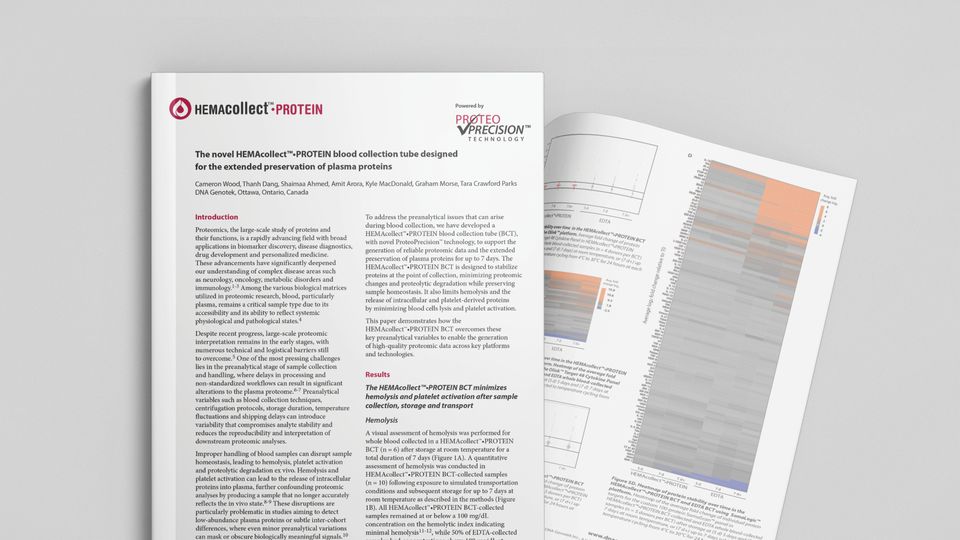
Proteomic research drives breakthroughs in biomarker discovery, disease diagnostics and precision medicine. Yet, preanalytical challenges such as hemolysis, platelet activation and protein degradation often compromise sample integrity and data reliability.
These issues are magnified when working with low-abundance proteins or subtle cohort differences, where even minor variability can obscure results. The need for a solution that maintains sample homeostasis and ensures assay compatibility is critical.
This whitepaper explores a novel blood collection tube (research use only) that provides extended plasma protein stability, limits preanalytical variability and supports high-quality data generation across multiple proteomic platforms.
Download this whitepaper to discover:
- How extended protein stability can improve reproducibility in proteomic studies
- How sample homeostasis minimizes data variability
- Compatibility of stabilized samples with mass spectrometry and affinity-based assays
PRECISION™
T E C H N O L O G Y
PRECISION™
T E C H N O L O G Y
Powered by
www.dnagenotek.com • support@dnagenotek.com
© 2025 DNA Genotek Inc., a subsidiary of OraSure Technologies, Inc., all rights reserved. PD-WP-80 v1
The novel HEMAcollect™•PROTEIN blood collection tube designed
for the extended preservation of plasma proteins
Cameron Wood, Thanh Dang, Shaimaa Ahmed, Amit Arora, Kyle MacDonald, Graham Morse, Tara Crawford Parks
DNA Genotek, Ottawa, Ontario, Canada
Introduction
Proteomics, the large-scale study of proteins and
their functions, is a rapidly advancing field with broad
applications in biomarker discovery, disease diagnostics,
drug development and personalized medicine.
These advancements have significantly deepened
our understanding of complex disease areas such
as neurology, oncology, metabolic disorders and
immunology.1-3 Among the various biological matrices
utilized in proteomic research, blood, particularly
plasma, remains a critical sample type due to its
accessibility and its ability to reflect systemic
physiological and pathological states.4
Despite recent progress, large-scale proteomic
interpretation remains in the early stages, with
numerous technical and logistical barriers still
to overcome.5 One of the most pressing challenges
lies in the preanalytical stage of sample collection
and handling, where delays in processing and
non‑standardized workflows can result in significant
alterations to the plasma proteome.6-7 Preanalytical
variables such as blood collection techniques,
centrifugation protocols, storage duration, temperature
fluctuations and shipping delays can introduce
variability that compromises analyte stability and
reduces the reproducibility and interpretation of
downstream proteomic analyses.
Improper handling of blood samples can disrupt sample
homeostasis, leading to hemolysis, platelet activation
and proteolytic degradation ex vivo. Hemolysis and
platelet activation can lead to the release of intracellular
proteins into plasma, further confounding proteomic
analyses by producing a sample that no longer accurately
reflects the in vivo state.8-9 These disruptions are
particularly problematic in studies aiming to detect
low-abundance plasma proteins or subtle inter-cohort
differences, where even minor preanalytical variations
can mask or obscure biologically meaningful signals.10
To address the preanalytical issues that can arise
during blood collection, we have developed a
HEMAcollect™•PROTEIN blood collection tube (BCT),
with novel ProteoPrecision™ technology, to support the
generation of reliable proteomic data and the extended
preservation of plasma proteins for up to 7 days. The
HEMAcollect™•PROTEIN BCT is designed to stabilize
proteins at the point of collection, minimizing proteomic
changes and proteolytic degradation while preserving
sample homeostasis. It also limits hemolysis and the
release of intracellular and platelet-derived proteins
by minimizing blood cells lysis and platelet activation.
This paper demonstrates how the
HEMAcollect™•PROTEIN BCT overcomes these
key preanalytical variables to enable the generation
of high-quality proteomic data across key platforms
and technologies.
Results
The HEMAcollect™•PROTEIN BCT minimizes
hemolysis and platelet activation after sample
collection, storage and transport
Hemolysis
A visual assessment of hemolysis was performed for
whole blood collected in a HEMAcollect™•PROTEIN
BCT (n = 6) after storage at room temperature for a
total duration of 7 days (Figure 1A). A quantitative
assessment of hemolysis was conducted in
HEMAcollect™•PROTEIN BCT-collected samples
(n = 10) following exposure to simulated transportation
conditions and subsequent storage for up to 7 days at
room temperature as described in the methods (Figure
1B). All HEMAcollect™•PROTEIN BCT-collected
samples remained at or below a 100 mg/dL
concentration on the hemolytic index indicating
minimal hemolysis11-12, while 50% of EDTA-collected
samples had concentrations above 100 mg/dL at
the 7-day timepoint. The plasma isolated from the
www.dnagenotek.com • support@dnagenotek.com
© 2025 DNA Genotek Inc., a subsidiary of OraSure Technologies, Inc., all rights reserved. PD-WP-80 v1 2
Hb concentration (mg/dL)
5 d 7 d T0 5 d 7 d
HEMAcollect™•PROTEIN EDTA
T0
0
50
100
150
200
B 250
HEMAcollect™•PROTEIN BCT has a slight brown
or amber hue, which may darken after collection,
unlike EDTA-derived plasma, which is straw-colored.
This differentiation originates from the color of the
stabilization liquid in the HEMAcollect™•PROTEIN BCT
and is distinct from the pink-to-red discoloration that
would be observed in hemolyzed samples collected in
standard EDTA tubes. Together, these data demonstrate
that the HEMAcollect™•PROTEIN BCT minimizes ex
vivo hemolysis when exposed to simulated transport
conditions and room temperature storage, while
providing additional flexibility in sample handling
compared with EDTA tubes.
Platelet activation
To evaluate platelet activation, ELISA-based assays were
conducted for the surface protein marker P-selectin
(CD62P), a classical platelet activation marker13, and
epidermal growth factor (EGF), which is released upon
platelet activation14. In this series of experiments, whole
blood was collected into HEMAcollect™•PROTEIN and
EDTA BCTs (n = 10 donors per BCT) and plasma was
isolated within 2 hours to represent baseline (T0).
Collected blood and isolated plasma samples were
exposed to simulated transport conditions, followed by
storage at room temperature for a total duration of 5 days
(5 d) or 7 days (7 d). Broadly, the data demonstrate
lower or equivalent concentrations of CD62P in all
HEMAcollect™•PROTEIN BCT conditions compared
with EDTA. Most notably, plasma isolated from whole
blood collected in the HEMAcollect™•PROTEIN BCT
(HCPP whole blood) in the 7 d condition had a lower
average fold change (7 d/T0) compared with the
matching 7 d condition in EDTA (EDTA whole blood)
(1.14 in the HEMAcollect™•PROTEIN BCT compared
with 2.10 in EDTA) (Figure 2A).
Consistent with the CD62P findings, plasma
EGF concentrations were lower or equivalent in
HEMAcollect™•PROTEIN BCT-collected samples
relative to EDTA across the same conditions (Figure
2B). Plasma isolated from whole blood collected in
HEMAcollect™•PROTEIN BCTs (HCPP whole blood)
in the 7 d condition had a lower average fold change
(7 d/T0) compared with the matching 7 d condition in
EDTA (EDTA whole blood) (12.24 in HCPP compared
with 127.25 in EDTA). Collectively, these results
indicate that the HEMAcollect™•PROTEIN BCT
limits ex vivo platelet activation in whole blood samples,
as represented by maintaining plasma concentrations
of CD62P and EGF.
A
Figure 1A. Visual assessment of ex vivo hemolysis. Image shows
whole blood collected in a HEMAcollect™•PROTEIN BCT after 7 days
of storage at room temperature (20°C-26°C/68°F-79°F).
Figure 1B. Quantitative measurement of ex vivo hemolysis after
extended storage and simulated transport. Concentration of
hemoglobin (mg/dL) in plasma derived from HEMAcollect™•PROTEIN
BCT-collected and EDTA-collected samples from 10 healthy donors at
(T0) baseline) or after simulated transport of whole blood subjected to
temperature cycling (4°C-30°C/39°F-86°F for a minimum of 24 hours at
each respective temperature), followed by storage at room temperature
(20°C-26°C/68°F-79°F) for a total duration of (5 d) 5 days or (7 d) 7 days.
www.dnagenotek.com • support@dnagenotek.com
© 2025 DNA Genotek Inc., a subsidiary of OraSure Technologies, Inc., all rights reserved. PD-WP-80 v1 3
The HEMAcollect™•PROTEIN BCT maintains
sample homeostasis, limiting preanalytical
variability after sample collection, storage
and transport
To evaluate blood sample homeostasis, the expression
of two biomarkers was evaluated: interleukin-8 (IL-8),
an intracellular cytokine prone to release from
leukocytes ex vivo15, and lectin-like oxidized LDL
receptor-1 (LOX-1), a membrane-associated protein
activated by proteolytic cleavage during sample
degradation16. The measurement of these two
proteins is indicative of the maintenance of blood
sample homeostasis over time.
Whole blood was collected into HEMAcollect™•PROTEIN
and EDTA BCTs (n = 10 donors per BCT) and plasma
was isolated within 2 hours to represent baseline (T0).
Collected blood and isolated plasma samples were
exposed to simulated transport conditions, followed
by storage at room temperature for a total duration
of 5 days (5 d) or 7 days (7 d).
Plasma isolated from whole blood collected in
HEMAcollect™•PROTEIN BCTs (HCPP whole blood)
in the 7 d condition had a lower average fold change
for IL-8 levels (7 d/T0) compared with the matching 7 d
condition in EDTA (EDTA whole blood) (0.90 in HCPP
compared with 111.7 in EDTA) (Figure 3A).
In addition, the HEMAcollect™•PROTEIN BCT
preserved LOX-1 levels near baseline (2.40-fold
increase at 7 d), indicating the suppression of
protease activity to support the maintenance
of the proteomic profile.16 In contrast, LOX-1
levels increased markedly in EDTA-collected
samples (11.26‑fold increase at 7 d) reflecting
elevated protease activity.16 These data indicate the
effective preservation of cellular integrity and reduced
ex vivo cytokine release in HEMAcollect™•PROTEIN
BCT-collected samples.
T0 5 d 7 d 7 d T0 5 d 7 d 7 d
0
50
100
150
200
CD62P (ng/mL)
HEMAcollect™•PROTEIN EDTA
HCPP whole blood
HCPP plasma
EDTA plasma
EDTA whole blood
A Storage condition
Figure 2A. ELISA-based evaluation of ex vivo platelet
activation via the measurement of CD62P concentrations
in HEMAcollect™•PROTEIN BCT-collected and EDTA-collected
samples. Samples collected from 10 healthy donors at (T0) baseline
or after simulated transport of whole blood subjected to temperature
cycling (4°C-30°C/39°F-86°F for a minimum of 24 hours at each
respective temperature) or plasma isolated at T0 (-10°C to 30°C/14°F
to 86°F for a minimum of 24 hours at each respective temperature),
followed by room temperature storage (20°C-26°C/68°F-79°F) for
a total duration of (5 d) 5 days or (7 d) 7 days.
Figure 2B. ELISA-based evaluation of ex vivo platelet
activation via the measurement of EGF concentrations in
HEMAcollect™•PROTEIN BCT-collected and EDTA-collected
samples. Samples collected from 10 healthy donors at (T0) baseline
or after simulated transport of whole blood subjected to
temperature cycling (4°C-30°C/39°F-86°F for a minimum of 24
hours at each respective temperature) or plasma isolated at T0
(-10°C to 30°C/14°F to 86°F for a minimum of 24 hours at each
respective temperature), followed by storage at room temperature
(20°C-26°C/68°F-79°F) for a total duration of (5 d) 5 days or (7 d) 7
days.
0
200
400
600
800
1000
EGF (pg/mL)
HCPP whole blood
HCPP plasma
EDTA plasma
EDTA whole blood
Storage condition
T0 5 d 7 d 7 d T0 5 d 7 d 7 d
HEMAcollect™•PROTEIN EDTA
B
www.dnagenotek.com • support@dnagenotek.com
© 2025 DNA Genotek Inc., a subsidiary of OraSure Technologies, Inc., all rights reserved. PD-WP-80 v1 4
The HEMAcollect™•PROTEIN BCT shows superior
performance and direct compatibility with
downstream proteomic technologies
The compatibility and robustness of the
HEMAcollect™•PROTEIN BCT was evaluated across
a variety of downstream proteomic technologies,
including untargeted mass spectrometry and
multi‑target, high-throughput affinity-based
proteomic platforms.
Mass spectrometry
To evaluate the compatibility of the
HEMAcollect™•PROTEIN BCT with mass
spectrometry workflows, whole blood was collected
into HEMAcollect™•PROTEIN and EDTA BCTs
(n = 4 donors per BCT ) and plasma was isolated within
2 hours to represent baseline (T0). First, compatibility
with an LC-MS/MS workflow was investigated, which
included 2 upfront abundant protein depletion kits.
Following depletion, HEMAcollect™•PROTEIN
BCT-derived samples showed a reduction in the most
abundant proteins, similar to that observed in EDTAderived
samples, as measured using a Bradford assay
(93% in HCPP vs. 85% in EDTA for Thermo Fisher™;
76% in HCPP vs. 78% in EDTA for Norgen™,
data not shown). This reduction demonstrates
the HEMAcollect™•PROTEIN BCT compatibility
with 2 common upfront depletion kits.
Next, following depletion and analysis using an LC-MS/
MS workflow, the total number of proteins detected was
found to be comparable between EDTA-collected and
HEMAcollect™•PROTEIN BCT-collected samples
with some notable differences (increased or decreased
abundance) in the EDTA samples (Figure 4A, 4B). For
example, some proteins known to be associated with
blood cell lysis and platelet activation were increased in
EDTA samples compared with HEMAcollect™•PROTEIN
BCT samples, depending on the depletion kit used
(HBB, PRDX2, ACTB, PBP and PF-4).17-20
Affinity-based proteomic platforms
The direct compatibility and performance of
HEMAcollect™•PROTEIN BCTs across a broader
subset of proteins was evaluated on the Olink™
proximity extension assay (PEA) and SomaLogic™
SomaScan™ assay. For this set of experiments, whole
0
10
20
30
40
500
1000
1500
2000
IL-8 (pg/mL)
HCPP whole blood
HCPP plasma
EDTA plasma
EDTA whole blood
Storage condition
T0 5 d 7 d 7 d
HEMAcollect™•PROTEIN
T0 5 d 7 d 7 d
EDTA
A
Figure 3A. ELISA-based evaluation of blood cell release via the
measurement of IL-8 concentrations in HEMAcollect™•PROTEIN
BCT-collected and EDTA-collected samples. Samples collected
from 10 healthy donors at (T0) baseline or after simulated transport
of whole blood subjected to temperature cycling (4°C-30°C/39°F to 86°F
for a minimum of 24 hours at each respective temperature) or plasma
isolated at T0 (-10°C to 30°C/14°F to 86°F for a minimum of 24 hours at
each respective temperature), followed by storage at room temperature
(20°C-26°C/68°F-79°F) for a total duration of (5 d) 5 days or (7 d) 7 days.
Figure 3B. ELISA-based evaluation of changes in LOX-1
concentrations in HEMAcollect™•PROTEIN BCT-collected and
EDTA-collected samples. Samples collected from 10 healthy donors
at (T0) baseline or after simulated transport of whole blood subjected
to temperature cycling (4°C-30°C/39°F-86°F for a minimum of 24 hours
at each respective temperature) or plasma isolated at T0 (-10°C to
30°C/14°F to 86°F for a minimum of 24 hours at each respective
temperature), followed by storage at room temperature
(20°C-26°C/68°F-79°F) for a total duration of (5 d) 5 days or (7 d) 7 days.
0
20
40
60
80
100
500
1000
1500
2000
3000
4000
5000
6000
7000
8000
9000
10000
LOX-1 (pg/mL)
HCPP whole blood
HCPP plasma
EDTA plasma
EDTA whole blood
Storage condition
T0 5 d 7 d 7 d
HEMAcollect™•PROTEIN
T0 5 d 7 d 7 d
EDTA
B
www.dnagenotek.com • support@dnagenotek.com
© 2025 DNA Genotek Inc., a subsidiary of OraSure Technologies, Inc., all rights reserved. PD-WP-80 v1 5
blood was collected into HEMAcollect™•PROTEIN
BCTs and EDTA BCTs and plasma was isolated within
2 hours to represent baseline (T0). Collected blood
samples were either stored at room temperature for
5 days (5 d) and 7 days (7 d) or exposed to simulated
transport conditions as described in the methods for
a total duration of 7 days (7 d+).
HEMAcollect™•PROTEIN BCT-derived samples
evaluated on the Olink™ Target 48 Cytokine Panel
revealed similar proteomic profiles relative to baseline
(T0) samples across all conditions tested (5 d, 7 d, 7 d+)
unlike EDTA-collected samples tested under the same
conditions (Figure 5A, 5B). After 7 days of storage, 85%
(34/40) of proteins remained stable within an average log2
fold change of ±1 (7 d/T0) in HEMAcollect™•PROTEIN
BCT-collected samples across donors (n = 4), contrasted
with EDTA-collected samples, which revealed that only
47.5% (19/40) of proteins remained within the same
threshold. Similarly, 80% (32/40) of proteins remained
stable within an average log2 fold change (7 d+/T0) of
±1 in the HEMAcollect™•PROTEIN BCT within the
7 d+ condition, whereas only 32.5% (13/40) of proteins
remained stable within EDTA (Figure 5A, 5B).
Consistent with the Olink™ panel data,
HEMAcollect™•PROTEIN BCT-derived samples
evaluated on a custom 100-protein SomaScan™ panel
demonstrated proteomic profiles similar to T0 samples
across all conditions tested (5 d, 7 d, 7 d+), comparable
to EDTA-collected samples under matched conditions
(Figure 5C, 5D). After 7 days of storage, 93% (93/100)
of proteins remained stable within an average log2 fold
change (7 d/T0) of ±1 in HEMAcollect™•PROTEIN
BCT-collected samples across donors (n = 5) in contrast
with EDTA-collected samples which revealed only 76%
(76/100) of proteins remained within the same threshold.
Similarly, 93% (93/100) of proteins remained stable
within an average log2 fold change (7 d+/T0) of ±1
in the HEMAcollect™•PROTEIN BCT in the 7 d+
condition, whereas only 69% (69/100) of proteins
remained stable within EDTA (Figure 5C, 5D).
Several markers (IL-8, LOX-1, PF-4, CTAP-III, NAP-2,
BTG, PDGF-AA and BDNF PBEF) associated with
cellular leakage, platelet activation, protease activity
and leukocyte activation are more controlled in
the HEMAcollect™•PROTEIN BCT compared with
the EDTA-collected samples.21-24 These findings
collectively support that the HEMAcollect™•PROTEIN
Figure 4. Detection of proteins using an LC-MS/MS workflow with common upfront depletion columns. Pooled HEMAcollect™•PROTEIN
BCT-derived samples were compared with pooled EDTA-derived samples (n = 4 donors per BCT) using a (A) Norgen™ depletion column or (B) Thermo
Fisher™ depletion column. Orange dots show proteins that are detected in greater abundance in EDTA-derived samples. Blue dots show proteins
that are detected in lower abundance in EDTA-derived samples. Grey dots show proteins that are not differentially detected in EDTA-derived samples
and are comparable to HEMAcollect™•PROTEIN BCT-derived samples.
www.dnagenotek.com • support@dnagenotek.com
© 2025 DNA Genotek Inc., a subsidiary of OraSure Technologies, Inc., all rights reserved. PD-WP-80 v1 6
14
12
10
8
6
4
2
0
-2
-4
Average log2 fold
change relative to T0
HEMAcollect™•PROTEIN EDTA
5 d 7 d 7 d+ 5 d 7 d 7 d+
A
Figure 5A. Protein stability over time in the HEMAcollect™•PROTEIN BCT
and EDTA BCT using the Olink™ platform. Average fold change of protein
targets for the Olink™ Target 48 Cytokine Panel in HEMAcollect™•PROTEIN
BCT-collected and EDTA whole blood-collected samples (n = 4 donors per BCT)
after storage at (5 d) 5 days and (7 d) 7 days) at room temperature, or (7 d+) up
to 7 days subjected to temperature cycling from 4°C to 30°C for 24 hours at each
temperature.
Figure 5B. Heatmap of protein stability over time in the HEMAcollect™•PROTEIN
BCT and EDTA BCT using the Olink™ platform. Heatmap of the average fold
change of individual protein targets for the Olink™ Target 48 Cytokine Panel
in HEMAcollect™•PROTEIN BCT-collected and EDTA whole blood-collected
samples (n = 4 donors per BCT) after storage at (5 d) 5 days and (7 d) 7 days at
room temperature, or (7 d+) up to 7 days subjected to temperature cycling from
4°C to 30°C for 24 hours at each temperature.
Figure 5C. Protein stability over time in the HEMAcollect™•PROTEIN BCT
and EDTA BCT using SomaLogic™ platform. Average fold change of protein
targets for the custom 100-protein SomaScan™ panel in HEMAcollect™•PROTEIN
BCT-collected and EDTA whole blood-collected samples (n = 5 donors per BCT)
after storage at (5 d) 5 days and (7 d) 7 days at room temperature, or (7 d+) up
to 7 days subjected to temperature cycling from 4°C to 30°C for 24 hours at
each temperature.
Figure 5D. Heatmap of protein stability over time in the
HEMAcollect™•PROTEIN BCT and EDTA BCT using SomaLogic™
platform. Heatmap of the average fold change of individual protein
targets for the custom 100-protein SomaScan™ panel in
HEMAcollect™•PROTEIN BCT-collected and EDTA whole blood-collected
samples (n = 5 donors per BCT) after storage at (5 d) 5 days and (7 d)
7 days at room temperature, or (7 d+) up to 7 days subjected to
temperature cycling from 4°C to 30°C for 24 hours at each temperature.
5 d 7 d 7 d+ 5 d 7 d 7 d+
Average log2 fold
change relative to T0
B Avg. fold
change log2
HEMAcollect™•PROTEIN EDTA
8
Average log� fold
change relative to T0
HEMAcollect™•PROTEIN EDTA
5 d 7 d 7 d+ 5 d 7 d 7 d+
6
4
2
0
-2
-4
C
www.dnagenotek.com • support@dnagenotek.com
© 2025 DNA Genotek Inc., a subsidiary of OraSure Technologies, Inc., all rights reserved. PD-WP-80 v1 7
BCT effectively minimizes preanalytical sample
changes by maintaining sample homeostasis, which
enables high-quality proteomic data generation.
Discussion
During the preanalytical phase, blood samples collected
for proteomics are vulnerable to stressors that can lead
to hemolysis, platelet activation, leukocyte activation
and protein degradation.7 These factors can significantly
compromise sample quality, potentially bias downstream
analyses and obscure the discovery of relevant
biomarkers.25 Our findings demonstrate that the
HEMAcollect™•PROTEIN BCT significantly mitigates
these issues across a range of storage and transport
conditions, providing a more robust BCT
for proteomic applications.
Specifically, the performance evaluation of the
HEMAcollect™•PROTEIN BCT highlights superior
flexibility in sample handling and processing enabled
by the ProteoPrecision™ technology, which minimizes
hemolysis, controls platelet activation and maintains
sample homeostasis in whole blood across a broad
temperature range. In addition, the reduced
variability observed across the data collected for
HEMAcollect™•PROTEIN BCT samples compared
with EDTA samples highlights the potential of
HEMAcollect™•PROTEIN BCTs to offer standardization
within current workflows for venous blood collection
and processing for proteomic applications.
Importantly, the performance data demonstrates
direct compatibility of the HEMAcollect™•PROTEIN
BCT on both traditional targeted immunoassays
(ELISA), untargeted mass spectroscopy (LC-MS/MS)
and 2 leading next generation, high-throughput
affinity-based proteomic platforms (Olink™ proximity
extension assay (PEA) and SomaLogic™ SomaScan™
assay). In addition to having direct compatibility with
HEMAcollect™•PROTEIN BCTs, these multi-target
protein panels emphasize the robust performance
of HEMAcollect™•PROTEIN BCTs in stabilizing the
plasma protein profile during storage and transport
conditions, showcasing the unique innovation of
ProteoPrecision™ technology. Through the effective
preservation of the whole blood sample, the
HEMAcollect™•PROTEIN BCT provides a sample
management solution that can facilitate discovery
using downstream proteomic technologies.
Conclusions
The HEMAcollect™•PROTEIN BCT sets a new standard
for venous blood sample collection in the rapidly
growing proteomics field. With a purpose-built design
to meet the unique demands of proteomic discovery
research, the HEMAcollect™•PROTEIN BCT
streamlines sample handling, enables extended sample
storage and transport at ambient temperature and
eliminates the constraints associated with standard
blood collection tubes. The HEMAcollect™•PROTEIN
BCT offers a scalable, highly assay-compatible, fieldready
solution that is positioned as a foundational tool
for the next generation of precision biomarker discovery
and translational research.
Materials and methods
Sample collection and processing
For all studies, paired venous blood samples
were collected from 6-10 healthy donors into
a HEMAcollect™•PROTEIN BCT and BD Vacutainer®
K2 EDTA (K2E) Plus BCT (Thermo Fisher Scientific,
Cat. No. 02-657-32). Baseline plasma (T0, control)
was isolated within 2 hours of collection and across
subsequent timepoints. At all timepoints, plasma was
isolated from the whole blood via centrifugation (1,900
× g for 15 minutes at 4°C) or as recommended by the
downstream assay manufacturer. All plasma samples
were stored at -80°C until they were tested.
Storage and transport conditions
The samples collected in the HEMAcollect™•PROTEIN
BCT and BD Vacutainer® K2 EDTA (K2E) Plus BCT
were exposed to 2 temperature conditions, which are
defined as room temperature storage (20°C–26°C/68°F–
79°F) and simulated transport (4°C-30°C/39°F-86°F
for whole blood; -10°C to 30°C/14°F to 86°F for isolated
plasma). The samples were stored for at least 24 hours at
each simulated transport temperature before being kept
at room temperature for up to 7 days.
www.dnagenotek.com • support@dnagenotek.com
© 2025 DNA Genotek Inc., a subsidiary of OraSure Technologies, Inc., all rights reserved. PD-WP-80 v1 8
Performance evaluation
The centrifuged BCTs were visually evaluated for
hemolysis following sample processing via a quantitative
assay for hemolysis (Abcam, Cat. No. ab234046).
To assess the maintenance of blood sample homeostasis,
ELISA-based immunoassays were carried out for
representative markers as a proxy for ex vivo platelet
activation (CD62P: Abcam, Cat. No. ab292202; EGF:
Abcam, Cat. No. ab217772), blood cell protein release
(IL-8: Abcam, Cat. No. ab214030) and broad protease
activity (LOX-1: Abcam, Cat. No. ab212161) using
plasma isolated from HEMAcollect™•PROTEIN and
EDTA BCTs.
Multi-target protein analysis on plasma isolates was
evaluated using high-throughput biomarker platforms,
including Olink™ Target 48 Cytokine Panel (Thermo
Fisher Scientific, Cat. No. CRLB-GMEL) and
the custom 100-protein SomaScan™ panel assay
(SomaLogic™). For the Olink™ panel, targets for which
at least 50% of donor values were below the limit of
detection (LoD) or were undetectable under all tested
conditions, were excluded from analysis, as their
inclusion would preclude a valid comparison.
For the SomaScan™ assay, plasma isolated from
HEMAcollect™•PROTEIN BCTs did not require
upfront buffer exchange processing.
Plasma isolated from four individual venous whole
blood donor samples were pooled and 5 replicates
were evaluated in HEMAcollect™•PROTEIN BCTs
for compatibility with 2 commercially available protein
depletion kits for preanalytical LC-MS sample
processing workflows, including the High-Select™
Top 14 Abundant Depletion Columns (Thermo Fisher
Scientific, Cat. No. A36371) and the ProteoSpin
Abundant Serum Depletion Kit (Norgen, Cat. No.
17300). Protein depletion efficiency was evaluated by
quantifying protein concentration using the Quick Start
Bradford Protein Assay Kit 1 (Bio-Rad, Cat. No.
5000201). Protein-depleted plasma samples collected
in a HEMAcollect™•PROTEIN BCT were compared
with BD Vacutainer® K2 EDTA (K2E) Plus BCT
(Thermo Fisher Scientific) and their respective
undepleted samples using Nano LC-MS/MS analysis
performed on an Ultimate3000 nano RLSC coupled to
an Orbitrap Fusion™ Lumos™ (Proteomics Core Facility,
University of Ottawa, April 2025) and analyzed using
MaxQuant.
References
1 Kline RA, Lößlein L, Kurian D, et al. (2022). An optimized comparative proteomic approach as a tool in neurodegenerative disease research.
Cells. 11(17):2653. doi: 10.3390/cells11172653
2 Park Y, Kim MJ, Choi Y, et al. (2022). Role of mass spectrometry-based serum proteomics signatures in predicting clinical outcomes and
toxicity in patients with cancer treated with immunotherapy. J Immunother Cancer. 10(3):e003566. doi: 10.1136/jitc-2021-003566
3 Costanzo M, Zacchia M, Bruno G, et al. (2017). Integration of proteomics and metabolomics in exploring genetic and rare metabolic diseases.
Kidney Dis (Basel). 3(2):66-77. doi: 10.1159/000477493
4 Geyer PE, Holdt LM, Teupser D, e al. (2017). Revisiting biomarker discovery by plasma proteomics. Mol Syst Biol. 13(9):942. doi: 10.15252/
msb.20156297
5 Chandramouli K, Qian PY. (2009). Proteomics: challenges, techniques and possibilities to overcome biological sample complexity. Hum
Genomics Proteomics. 239204. doi: 10.4061/2009/239204
6 Hassis M, Niles RK, Braten MN, et al. (2015). Evaluating the effects of preanalytical variables on the stability of the human plasma proteome.
Anal Biochem. 478:14-22. doi: 10.1016/j.ab.2015.03.003
7 Magnette A, Chatelain M, Chatelain B, et al. (2016). Pre-analytical issues in the haemostasis laboratory: guidance for the clinical laboratories.
Thromb J. 14:49. doi: 10.1186/s12959-016-0123-z
8 Tu C, Rudnick PA, Martinez MY, et al. (2010). Depletion of abundant plasma proteins and limitations of plasma proteomics. J Proteome Res.
9(10):4982-91. doi: 10.1021/pr100646w
9 Kamlage B, Maldonado SG, Bethan B, et al. (2014). Quality markers addressing preanalytical variations of blood and plasma processing
identified by broad and targeted metabolite profiling. Clin Chem. 60(2):399-412. doi: 10.1373/clinchem.2013.211979
10 Chantada-Vázquez MDP, Bravo SB, Barbosa-Gouveia S, et al. (2022). Proteomics in inherited metabolic disorders. Int J Mol Sci. 23(23):14744.
doi: 10.3390/ijms232314744
11 Candia J, Fantoni G, Moaddel R, et al. (2025). Effects of in vitro hemolysis and repeated freeze–thaw cycles in protein abundance
quantification using the SomaScan and Olink assays. Journal of Proteome Research. 24(5): 2517-2528. doi: 10.1021/acs.jproteome.5c00069
12 Anwar M, Renu K, Singh A, et al. (2025). Impact of hemolysis on the levels of proteins associated with aging and age-related
neurodegenerative diseases in a multicentric clinical research. Practical Laboratory Medicine. 44; e00455. doi: 10.1016/j.plabm.2025.e00455
The Olink and SomaScan trademarks are properties of their respective owners.
Some DNA Genotek Inc. products are not available in all geographic regions.
HEMAcollect and ProteoPrecision are trademarks of DNA Genotek Inc., registered in various jurisdictions.
All other brands and names contained herein are the property of their respective owners.
HEMAcollect™•PROTEIN BCT is for Research Use Only, not for use in diagnostic procedures.
All DNA Genotek™ protocols, white papers and application notes are available in the support section of our website at www.dnagenotek.com.
Customers must review the labels of sample collection devices and ensure compliance with their intended requirements.
For more information or to request samples or a quote, visit www.dnagenotek.com or email info@dnagenotek.com.
For technical support, email support@dnagenotek.com.
www.dnagenotek.com • support@dnagenotek.com
© 2025 DNA Genotek Inc., a subsidiary of OraSure Technologies, Inc., all rights reserved. PD-WP-80 v1 9
13 Sano Y, Tomiyama T, Yagi N, et al. (2024). Platelet activation through CD62P and the formation of platelet–monocyte complexes are
associated with the exacerbation of mucosal inflammation in patients with ulcerative colitis. Scientific Reports. 14:28055. doi: 10.1038/
s41598-024-78462-8
14 Chen R, Jin G, Li W, et al. (2018). Epidermal growth factor (EGF) autocrine activation of human platelets promotes EGF receptor–dependent
oral squamous cell carcinoma invasion, migration, and epithelial mesenchymal transition. J Immunol. 201(7):2154-2164 doi: 10.4049/
jimmunol.1800124.
15 Liebers V, Kendzia B, Stubel H, et al. (2018). Cell activation and cytokine release ex vivo: estimation of reproducibility of the whole-blood
assay with fresh human blood. Adv Exp Med Biol. 1108:25-36. doi: 10.1007/5584_2018_225
16 Mentrup T, Cabrera-Cabrera F, Schröder B. (2021). Proteolytic regulation of the lectin-like oxidized lipoprotein receptor LOX-1. Front
Cardiovasc Med. 7:594441. doi: 10.3389/fcvm.2020.594441
17 Searfoss R, Shah P, Ofori-Mensa K, et al. (2022). Impact of hemolysis on multi-OMIC pancreatic biomarker discovery to derisk biomarker
development in precision medicine studies. Sci Rep. 12(1):1186. doi: 10.1038/s41598-022-05152-8
18 Romanello KS, Teixeira KKL, Silva JPMO, et al. (2018). Global analysis of erythroid cells redox status reveals the involvement of Prdx1 and
Prdx2 in the severity of beta thalassemia. PLoS One. 13(12):e0208316. doi: 10.1371/journal.pone.0208316
19 Geyer P, Kulak N, Pichler G, et al. (2016). Plasma proteome profiling to assess human health and disease. Cell Systems. 23 :185-195.
20 Ji Y, Zhang Q, Li H, et al. (2025). Platelet factor 4: A mysterious chemokine in inflammatory regulation diseases. Journal of Inflammation
Research. 18 :4481-4495.
21 Kofanova O, Henry E, Quesada R, et al. (2018). IL8 and IL16 levels indicate serum and plasma quality. Clinical Chemistry and Laboratory
Medicine (CCLM). 56(7):1054-1062. doi: 10.1515/cclm-2017-1047
22 Pilatova K, Greplova K, Demlova R, et al. (2013). Role of platelet chemokines, PF-4 and CTAP-III, in cancer biology. Journal of Hematology
and Oncology. 6:42. doi: 10.1186/1756-8722-6-42
23 Zabczyk M, Natorska J, Matusik P, et al. (2023). Neutrophil-activating peptide 2 as a novel modulator of fibrin clot properties in patients with
atrial fibrillation. Translational Stroke Research. 15:773-783. doi: 10.1007/s12975-023-01165-1
24 Ludlam C. (1979). Evidence for the platelet specificity of beta-thromboglobulin and studies on its plasma concentration in healthy individuals.
Br J Haematol. 41(2):271-8. doi: 10.1111/j.1365-2141.1979.tb05855.x
25 Agrawal L, Engel K, Greytak S, et al. (2017). Understanding preanalytical variables and their effects on clinical biomarkers of oncology and
immunotherapy. Seminars in Cancer Biology. 52:26-38.