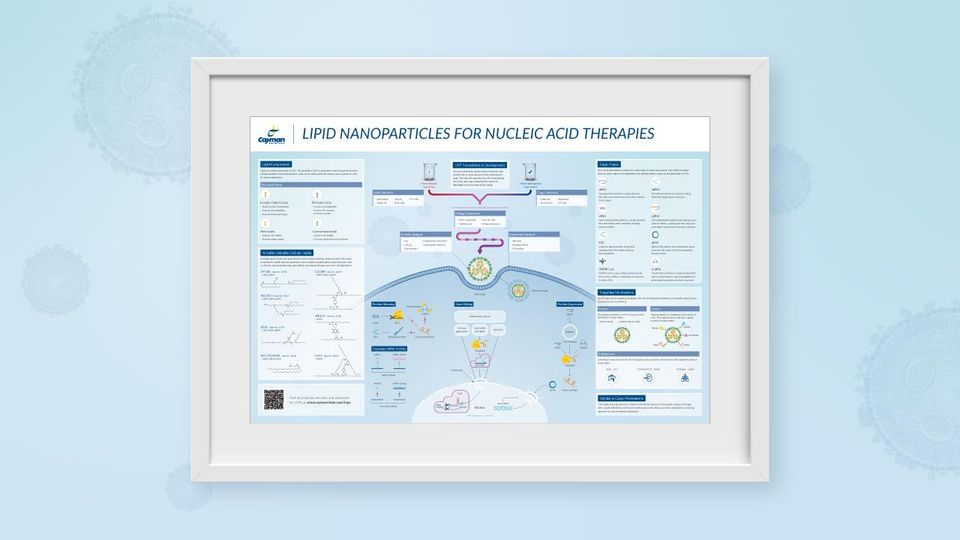
Lipid nanoparticles (LNPs) have emerged as a powerful delivery platform for nucleic acid-based treatments, driven by innovations in lipid composition and formulation techniques.
As therapeutic strategies evolve, the need for precision delivery systems that protect cargo and enhance cellular uptake has never been greater. Researchers face challenges in optimizing lipid ratios, achieving endosomal escape and maintaining stability across diverse nucleic acid payloads.
This poster highlights key lipid components, formulation variables and targeting strategies that define modern LNP development, offering insight into how these elements influence therapeutic outcomes.
Download this poster to explore:
- How lipid composition impacts cargo protection, delivery and uptake
- The role of mixing parameters and formulation choices in LNP performance
- Strategies for tuning LNPs to specific tissues and therapeutic targets
Lipid Components
Lipids are critical components of LNPs. The versatility of LNPs is achievable in part through the diversity
of lipids available for these applications. Lipids can be used to tailor the behavior and properties of LNPs
for various applications.
LNP Formulation & Development
LNPs are prepared by rapidly mixing an ethanolic lipid
solution with an acidic aqueous buffer containing the
cargo. The lipids self-assemble into LNPs encapsulating
the nucleic acid cargo, protecting the cargo from
degradation and promoting cellular uptake.
Ionizable Cationic Lipids
· Protect nucleic acid payloads
· Improve biocompatibility
· Promote endosomal escape
Sterol Lipids
· Improve LNP stability
· Promote cellular uptake
PEGylated Lipids
· Increase biocompatibility
· Prevent LNP clearance
by immune system
Glycerophospholipids
· Improve LNP stability
· Fine-tune physicochemical properties
Key Lipid Types
Mix ethanolic lipid mixture and acidic aqueous cargo solution
Mixing Parameters
· Buffer composition
· Total flow rate
· Flow rate ratio
· Mixing architecture
Prepare acidic aqueous
cargo solution
Prepare ethanolic
lipid mixture
Lipid Selection
· Lipid species
· Target cell
· Lipid pK
a
· Molar ratio
· N:P ratio
Cargo Selection
· Cargo type
· Site of action
· Application
· N:P ratio
Ionizable cationic lipids have great structural and functional diversity, endowing them with unique
properties for specific delivery applications. Some notable ionizable cationic lipids have been used
in LNPs for vaccine development, gene editing, rare disease therapies, and CAR T cell applications.
SM-102 - Item No. 33474
· mRNA, pDNA
O
O
N
OH
O
O
ALC-0315 - Item No. 34337
· mRNA, siRNA, pDNA
DLin-MC3-DMA - Item No. 34364
· mRNA, siRNA, pDNA
C12-200 - Item No. 36699
· mRNA, siRNA, saRNA
cKK-E12 - Item No. 36700
· mRNA
C14-4 - Item No. 38942
· mRNA
LP-01 - Item No. 37278
· Cas9 mRNA, sgRNA
O
O
N
N
OH
N
HO OH
N N
N
OH OH
O N
OH
N
OH OH
N N
O
N
HO
HO
HO
N O
O
O
O
N
OH OH
N
H
O
H O
N
N
OH OH
O
O
O
O O
N
O
O
O
O
Notable Ionizable Cationic Lipids
LIPID NANOPARTICLES FOR NUCLEIC ACID THERAPIES
Particle Analysis
· Size
· LNP pK
a
· Zeta potential
· Polydispersity index (PDI)
· Encapsulation efficiency
Expression Analysis
· Efficiency
· Biological effects
· Cell viability
pDNA
siRNA
ASO Endogenous mRNA
RISC
No protein synthesis
circRNA
Protein sponges
saRNA
mRNA
Translation
Self-replication
circRNA
ASO
Antisense oligonucleotides (ASOs) bind
complementary RNA targets, inducing
their degradation.
mRNA
Messenger RNA (mRNA) is a single-stranded
RNA that carries instructions for protein synthesis
in the cytosol.
siRNA
Small interfering RNA (siRNA) is a double-stranded
RNA that inhibits mRNA translation, blocking
protein synthesis.
circRNA
Circular RNA (circRNA) is a single-stranded RNA
with a circular structure, improving stability and
promoting long duration of protein expression.
saRNA
Self-amplifying RNA (saRNA) self-replicates upon
cytosolic delivery, requiring less RNA cargo and
promoting a long duration of protein expression.
pDNA
Plasmid DNA (pDNA) carries therapeutic genes
to human cells, where it must be transported
into the nucleus.
miRNA
MicroRNAs (miRNAs) are small non-coding
RNAs that regulate gene expression.
Cargo Types
LNPs are tunable delivery systems for a wide range of nucleic acid cargoes. Their ability to protect
these sensitive cargoes from degradation and facilitate cellular uptake are key advantages of LNPs.
CRISPR-Cas9
CRISPR-Cas9 is a gene editing tool that permits
the removal, addition, or alteration of a sequence
in cellular DNA.
Targeting Mechanisms
By leveraging various targeting strategies, LNPs can be recognized and taken up by specific organs, tissues,
and cells during in vivo delivery.
The physical properties of LNPs are tuned to tailor
distribution to target organs.
· Surface charge · Ionizable cationic lipids
Targeting ligands are conjugated to the surface of
LNPs. These ligands interact with their cognate
receptors in target organs.
Passive Active
Endogenous
Certain lipid components of LNPs bind endogenous serum proteins, which interact with cognate receptors in
target organs.
ApoE - Liver Complement C3 - Spleen Fibrinogen - Lungs
Fatty acid
Protein
Antibody
Peptide
Carbohydrate
Endocytosis
Endosomal escape
Uptake & Cargo Mechanisms
LNP uptake and cargo delivery is critical for the efficient transport of therapeutic cargoes into target
cells. Cargoes delivered by LNPs can be used to tailor many cellular processes, making them a promising
approach for many therapeutic applications.
Protein Silencing
Targeting miRNA Activity
Gene Editing Protein Expression
CRISPR-Cas9 Systems
Cas9 and
sgRNA pDNA
Cas9 mRNA
and sgRNA
Cas9 RNP
Protein synthesis
Translation
Transcription
Replicase
Nuclear pore
Nucleus
© 2024 Cayman Chemical · November 2024
Find all products, services, and resources
for LNPs at www.caymanchem.com/lnps
Cas9 RNP
Cas9
sgRNA
DNA
miRNA miRNA mimics
antimiR miRNA sponge
miRNA Activity
No miRNA Activity