Advance Precision Medicine Through Integrated Multi-Omics Patient Data
eBook
Published: September 16, 2025
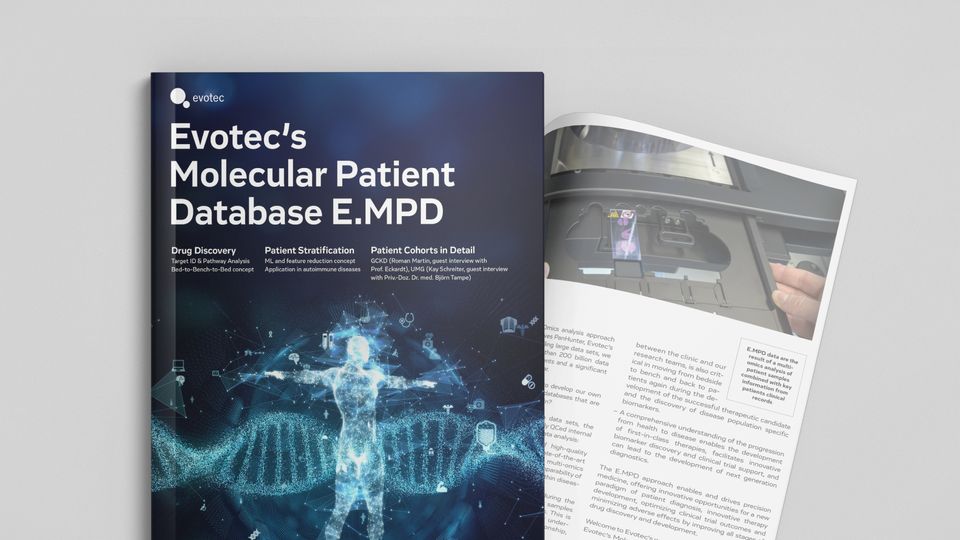
Credit: Evotec
The pharmaceutical industry struggles with high drug development failure rates and limited understanding of patient heterogeneity in complex diseases like chronic kidney disease, cardiovascular disorders and autoimmune conditions.
Traditional patient classification methods fail to capture the molecular complexity driving disease progression, resulting in ineffective treatments and poor clinical outcomes.
This eBook demonstrates how integrated multi-omics patient databases revolutionize precision medicine by combining molecular data with clinical insights to accelerate therapeutic discovery and enable personalized treatments.
Download this eBook to discover:
- How multi-omics integration transforms patient stratification and biomarker discovery
- Real-world case studies of successful target identification in chronic diseases
- Machine learning approaches for analyzing patient datasets and predicting treatment responses
Evotec’s
Molecular Patient
Database E.MPD
Patient Cohorts in Detail
GCKD (Roman Martin, guest interview with
Prof. Eckardt), UMG (Kay Schreiter, guest interview
with Priv.-Doz. Dr. med. Björn Tampe)
Drug Discovery
Target ID & Pathway Analysis
Bed-to-Bench-to-Bed concept
Patient Stratification
ML and feature reduction concept
Application in autoimmune diseases
A Note From
Our CSO
Welcome to the first edition of our new e-book – a
refreshed format created to share forward-thinking
insights into Shared R&D, innovative technologies,
and the science that powers Evotec.
Building on the legacy of Drug Discovery Update (DDup), this
publication
now offers a broader view of our capabilities and
collaborative approach across the R&D continuum.
In this first issue, we are excited to highlight E.MPD, Evotec’s
Molecular Patient Database – a groundbreaking platform at the
heart of our precision medicine approach. E.MPD integrates
high-quality molecular data with clinical insights, enabling a
molecular understanding of disease biology and accelerating
the development of personalized therapies. This platform exemplifies
our commitment to driving data-driven innovation,
fostering collaboration, and developing innovative treatment
options that make a real difference for patients in the future.
Aligned with our purpose to develop life-changing medicines and
our vision to accelerate the journey from concept to cure, this
format offers a closer look at how we work, what drives us, and
the opportunities our platforms create. Whether you’re familiar
with Evotec or just getting to know us, we hope this publication
provides valuable insights and inspiration.
Thank you for joining us on this journey.
Warm regards,
Cord Dohrmann
The Authors
Questions?
Contact us!
Cord Dohrmann
Chief Scientific Officer
info@evotec.com
Roman Martin
Senior Research Scientist
Hanna Schebet
Senior Research Scientist
Ricardo Castro
Research Associate
Lavanya
Muthukrishnan
Research Scientist
Tobias
Bohnenpoll
Senior Research Scientist
Olivier Radresa
SVP Head of Nephrology
Kay Schreiter
Principal Scientist
Uwe Andag
EVP Head of
Therapeutic Areas
Evotec’s Molecular Patient Database E.MPD 3
Contents
1
Page 6
Evotec’s Molecular Patient
Database (E.MPD)
Evotec’s Molecular Patient Database E.MPD 4
2Patient Cohorts in Detail
2.1 Insights from Prof. Kai-Uwe Eckardt:
CKD Research Page 8
2.2 Advances with Priv.-Doz. Dr. med.
Björn Tampe: Vasculitis Treatments
Page 12
3.1 Target Identification &
Pathway Analysis
Chronic Kidney Disease (CKD) Page 20
Cardiovascular Disease (CVD) Page 22
3.2 Bed-to-Bench-to-Bed Concept:
A Case Study Page 24
3Drug Discovery
6.1 Empowering Multi-Omics Analysis
Page 26
6Evotec’s Vision
6.2 Future Directions in Precision Medicine
Page 27
4.2 Application in Autoimmune Diseases
Chinook Collaboration Page 15
Systemic Lupus Erythematosus (SLE)
Case Study Page 18
4.1 Machine Learning in Precision Medicine
Page 14
4 Patient Stratification and AI
5Molecular Innovations
5.1 Unbiased Molecular Classification
of CKD Page 10
5.2 ADPKD Case Study: PanOmics
Research for Biomarker Identification
Page 21
Evotec’s Molecular Patient Database E.MPD 5
E.MPD: Evotec’s
Molecular Patient
Database
by Uwe Andag and Philipp Skroblin
Using human data as a starting point
for drug discovery programs should
greatly improve the probability of success
during development of novel innovative
treatment options for patients.
With this in mind, Evotec began a few
years ago to build an in-house molecular
patient database in close collaboration
with academic partners
and major hospitals. Since then, Evotec’s Molecular
Patient Database
(E.MPD) has become a major component
in daily research and development processes
at Evotec, underpinning our long-term vision that
starts with the patient and ends with the patient’s
benefit.
The E.MPD basically started with acquisition of
data relating to chronic kidney disease (read more in
DDup #7), and has successfully been expanded into
other important therapeutic areas such as metabolic
and immune-mediated diseases.
The database is a result of a multi-omics (“PanOmics”)
analysis of patient samples combined with key information
from patient’s clinical records. The PanOmics
analysis
includes classical genomics and transcriptomics,
high-resolution and spatial transcriptomics as
well as high-throughput, state-of-the-art proteomics
to validate our findings at a protein level.
Evotec’s Molecular Patient Database E.MPD 6
By applying a holistic PanOmics analysis approach
to patient samples that involves PanHunter, Evotec’s
proprietary software for handling large data sets, we
were able to generate more than 200 billion data
points from over 25,000 patients and a significant
number of healthy controls, so far.
Why have we made this effort to develop our own
database when there are already databases that are
readily available in the public domain?
Compared to many public domain data sets, the
following reasons highlight why a fully QCed internal
database is superior for subsequent data analysis:
– Evotec controls the acquisition of high-quality
PanOmics data leveraging inhouse state-of-the-art
high-throughput and high-resolution multi-omics
technologies, which allows for data comparability of
different sample & analysis batches, within diseases
and between disease states.
– Evotec engages closely with clinicians during the
acquisition of high-quality clinical patient samples
and data prior to and during clinical trials. This is
important for study planning and a clear understanding
of patient-centric data. The relationship,
between the clinic and our
research teams, is also critical
in moving
from bedside
to bench and back to patients
again during the development
of the successful therapeutic candidate
and the discovery of disease population specific
biomarkers.
– A comprehensive understanding of the progression
from health to disease enables the development
of first-in-class therapies, facilitates innovative
biomarker discovery and clinical trial support, and
can lead to the development of next generation
diagnostics.
The E.MPD approach enables and drives precision
medicine, offering innovative opportunities for a new
paradigm of patient diagnosis, innovative therapy
development, optimizing clinical trial outcomes and
minimizing adverse effects by improving all stages of
drug discovery and development.
Welcome to Evotec’s world of PanOmics
in the E.MPD,
Evotec’s Molecular
Patient Database!
E.MPD data are the
result of a multiomics
analysis of
patient samples
combined with key
information from
patients clinical
records
Evotec’s Molecular Patient Database E.MPD 7
Interview with
Prof. Dr. Kai-Uwe Eckardt by Roman Martin
Prof. Dr. Eckhardt, thank you for joining us today.
Could you start by providing an overview of the
GCKD cohort and its primary objectives? Thank you for having me. The German
Chronic Kidney Disease (GCKD) cohort
study is one of the world’s largest studies
focused on chronic kidney disease
(CKD). It was established to investigate the various
factors contributing to the progression and complications
of CKD. Our primary objectives include identifying
genetic, environmental, and lifestyle factors
that influence CKD. The comprehensive collection
of bio-samples and clinical data will enable us to discover
biomarkers for rapid progression and hopefully
also targets for novel therapies.
Could you explain the design and structure of the
GCKD cohort study and why it is special compared
to other large kidney cohort studies?
The GCKD study was designed as a prospective observational
study. We recruited over 5,000 participants
with moderately advanced CKD from nephrology outpatient
clinics across Germany. With that multicentric
approach we were able to compile one of the largest
CKD cohorts worldwide. The participants underwent
comprehensive baseline assessments, including de-
Prof. Dr. Kai-Uwe Eckardt is a distinguished nephrologist and
researcher with extensive experience in the field of chronic kidney
disease (CKD). He holds a degree in human medicine from the
University of Münster and completed his clinical training in internal
medicine and nephrology at several prestigious institutions,
including Hannover Medical School, University of Zürich, University
of Oxford, University of Regensburg, Charité - Berlin and University
Medical Centre Erlangen. Between 2004 and 2017, he was
Chair of the Department of Nephrology and Hypertension at the
Friedrich-Alexander-Universität of Erlangen-Nürnberg. Since 2017
he has held the position of clinic director for internal medicine with
focus on nephrology and intensive care at the Charité. Prof. Dr. Kai-
Uwe Eckardt is the funding principal investigator of the German
Chronic Kidney Disease (GCKD) study, one of the largest and most
comprehensive studies of its kind worldwide. His work has been
published in numerous high-impact scientific journals, and he has
received multiple awards for his contributions to nephrology and
translational medicine.
About
tailed questionnaires, physical examinations, and laboratory
tests. Standardization as well as manual curation
ensure high data quality. We collected a number of blood
and urine samples at baseline and during follow-up visits
every two to three years, to establish a central biobank.
The longitudinal design allows us to monitor disease
progression and the emergence of complications
over time. With the first patients recruited in 2009,
GCKD is also among the longest running studies in the
kidney disease field. The high level of retention of our
patients was only possible through the great dedication
of all GCKD members.
In 2021 you entered a collaboration with Evotec –
what are the key benefits of this partnership for
GCKD?
We were very happy to collaborate with Evotec, one
of the leading companies in pharmaceutical renal research.
Funding provided by Evotec and the retention
of our highly motivated participants was key to extend
the follow up. This allowed continuation of the GCKD
study for an additional 4 years, including one additional
visit for collection of follow-up samples from nearly
1,500 participants.
Evotec’s Molecular Patient Database E.MPD 8
Besides this, we are intrigued by the capacity of Evotec
for performing and analyzing large scale omics
data. Here we rely on the high-quality sample processing
pipelines at Evotec as well as the advanced
multi-omics data analysis platform, PanHunter, which
will enable direct access to the omics data for GCKD
scientists. The fact that the agreement with Evotec
was to share all data generated from the study
samples was crucial for GCKD. I am confident that
the joint analysis will also in future inspire multiple
sub-projects of Evotec and GCKD affiliates.
What are the key benefits that you expect from the
mentioned joint sample analysis, from your point of
view? How will this impact medical care in future?
We are especially excited about the transcriptomics results
from approx. 4,500 blood samples, including two
time points, that we provided to Evotec. This data will
allow us to examine gene expression patterns. Use of
Evotecs multi-omics data analysis platform will provide
fast access to the data and state-of-the-art analysis
tools for GCKD scientists. We anticipate that this data
will inspire close scientific collaborations. Together, we
aim to gain a deeper understanding of the molecular
mechanisms driving CKD progression. The longitudinal
design of the study will also provide highly valuable
data showing how gene expression patterns change
in response to various clinical and live-style factors.
Application of machine learning algorithms developed
together with Evotec will hopefully lead to the
identification of new molecular biomarkers for early
detection of high risk disease progression, as well
as potential therapeutic targets. Together these insights
will pave the way for personalized medicine
approaches tailored to individual patient profiles.
Are there further omics analysis planned apart from
RNA sequencing?
Indeed, we believe that the full benefit of omics technologies
requires analysis at multiple levels. We are
therefore also generating data using other omics
technologies. This is possible because of the rich
biosample collection that GCKD established. We
also provided plasma and urine samples to Evotec for
additional analyses in the framework of the collaboration.
Importantly, the results of such analyses will also
be shared with GCKD investigators. Apart from that,
we are now collecting biopsy samples in a retrospective
sub-project together with Evotec. GCKDs rich
biobank even enabled the support a recent subproject
with Evotec in which we used snap-frozen blood for
single cell analysis.
What challenges do you foresee in this collaboration,
and how do you plan to address them?
One of the main challenges is the integration and
analysis
of large and complex datasets generated from
multi-omics approaches. Ensuring data quality, reducing
batch effects and grant consistency across different
omics platforms is crucial. To address this, experts
from GCKD are collaborating closely with experts from
Evotec. We will employ Evotec‘s production-ready
sample processing pipelines as well as the robust bioinformatics
toolkits provided by PanHunter. Within
GCKD we are collaborating across different centers to
incorporate diverse scientific expertise, in particular, we
are able to rely on the great expertise in data science
and systems biology from Prof. Dr. Köttgen‘s group at
the University of Freiburg.
Another challenge is translating molecular findings into
clinical practice. This requires validation studies and
close collaboration with clinicians to ensure that our
findings are applicable and beneficial in a real-world
setting. GCKD provides a unique network including
the leading experts in kidney disease and also collaborate
with various international partners, e.g. within
the CKD Prognosis Consortium. A continual dialogue
between academics, clinics and industry partners in a
multidisciplinary approach will be key to overcoming
these challenges associated with CKD.
Finally, how do you envision the long-term impact
of this collaboration on CKD research and patient
care?
In the long term, this collaboration has the potential
to significantly advance our understanding of CKD.
By identifying new biomarkers and therapeutic targets,
we can develop more effective and personalized
treatments. This could lead to earlier diagnosis,
improved patient stratification and better disease
management. Ultimately, our goal is to reduce the
burden of CKD on patients and healthcare systems,
and collaborations like this are essential to achieving
that vision.
Evotec’s Molecular Patient Database E.MPD 9
by Kay Schreiter
Interview with
Priv.-Doz. Dr. med. Björn Tampe on
ANCAVasculitis
Evotec’s Molecular Patient Database E.MPD 10
ANCA (Antineutrophil Cytoplasmic Antibody)-
associated vasculitis is a heterogeneous
autoimmune disorder characterized
by the production of autoantibodies
against molecules in the cytoplasm of neutrophils,
white blood cells that play an important role in the immune
system fighting infection and inflammation. The
production of autoantibodies leads to inflammation of
small blood vessels, which involves multiple organs,
especially the kidney.
Current therapies are restricted to the depletion of
B-cells, a type of white blood cell that neutrophils interact
with (Rituximab) and the inhibition of the part
of the innate immune system known as complement
(Avacopan).
Early diagnosis and current immunosuppressive therapies
have shifted the focus to managing remission,
addressing complications such as renal involvement,
infections, and cardiovascular risk, as well as predicting
relapses, which remain significant challenges. A
comprehensive understanding of autoimmune diseases
like ANCA-associated vasculitis enables proper
patient stratification and innovative biomarker discovery
for treatment selection, treatment monitoring
and, relapse prediction. A better understanding of the
system biology of these diseases can lead to the improved
development of next generation diagnostics
to enhance clinical trial support and to even better
therapies.
Evotec’s Molecular Patient Database E.MPD 11
5 minutes with
Björn Tampe
interviewed
by Kay Schreiter
Why is it important to study autoimmune diseases,
especially ANCA-associated vasculitis? Autoimmune diseases are very common.
Worldwide, 5 to 10 % of the population
is affected by at least one of 80 to 100
different autoimmune diseases. One of
these autoimmune diseases is ANCA-associated vasculitis,
which is a prototypical disease induced by auto-
antibodies. For ANCA-associated vasculitis, a very
good treatment protocol exists and the progression
of disease is, for the most part, well understood. This
enables efficient patient monitoring and supports the
standardized collection of patient samples, which is
the fundamental basis of the non-interventional patient
cohort study with Evotec.
The course of the disease, which is not a heterogeneous
one, can be described very well and can be
compared between different patients. This offers the
opportunity to gain deep insights into this disease,
which is translatable to the understanding of other
autoimmune diseases.
About
The treatment of ANCA-associated vasculitis encompasses
an induction and a maintenance therapy.
The challenge in this context is a immunosuppression
balanced between disease control but also risk of
infectious complications. Therefore, non-invasive biomonitoring
is required enabling a tailored use of immunosuppressive
regimens. This becomes essential when
disease remission is achieved and the prediction of
potential relapse of the disease is needed.
Commonly used treatment regimens with immunosuppressants
include the approved treatment with
Rituximab, a B-cell depleting therapy, that is given for
long-term therapy and is also used in the treatment of
other autoimmune diseases.
Avacopan, which has recently been approved for
ANCA-associated vasculitis, provides a treatment alternative.
It is an oral complement-system inhibitor.
What is unique about this ANCA-vasculitis cohort or
different from other initiatives?
In addition to the non-interventional study with Evotec,
University Medical Center Göttingen (UMG) is also involved
in clinical trial studies, where the UMG is among
the top hospitals and specialist clinics for the recruitment
of ANCA-associated vasculitis patients. Nevertheless,
the cohort with Evotec is quite unique as we will
achieve one of the largest number of patients enrolled
worldwide for ANCA-associated vasculitis outside of
clinical trials, despite the rarity of the disease. It is also
noteworthy that the diagnostic kidney biopsy, which is
carried out for each patient in the study, is accompanied
by a simultaneous blood sampling and single cell data,
which are generated directly from a fresh blood sample
at the Evotec research laboratory. This is essential
Priv.-Doz. Dr. med Björn Tampe is an established specialist in
nephrology, immunology and critical care medicine. After his degree in
human medicine from the University of Göttingen, he spent his postdoc
at the Harvard Medical School in Boston. Thereafter, he joined
the Department of Nephrology and Rheumatology at the University
Medical Center Göttingen where he is executive assistant medical
director and head of intensive care medicine. He focuses on translational
research in kidney disorders, connecting experimental findings
to clinical implications. This includes autoimmunity in vasculitis,
immune
checkpoint inhibitor-associated complications, inflammation
and organ fibrosis. He has more than 100 peer reviewed publications
and received several awards for his contributions to nephrology and
translational medicine.
Evotec’s Molecular Patient Database E.MPD 12
for our collaborative research project where correlation
of the biopsy directly with the blood can lead to new
biomarkers for diagnostics. The proximity of UMG to
Evotec and the timely analysis of the unique patient
samples using the latest omics technologies available
at Evotec in Göttingen is absolutely crucial here. The
fastest possible analysis makes it possible to understand
cellular relationships before the cells and systemic
processes in the blood can change due to the transport
or storage of the samples. This gives us a direct
image of the systemic changes in the patient’s samples.
What novel insights do you expect from the
ANCA-associated vasculitis cohort study?
A comprehensive mechanistic understanding of patient
stratification. A new classification of patients
based on multi-omics data with regard to pathogenesis,
treatment response and relapse. To date, there
are no predictions about a possible relapse for these
patients and no good definition of a partial or complete
relapse. So far, no procedures have prevailed in
everyday clinical practice. As part of today’s treatment
regimen patients receive a fixed dose of Rituximab
regardless of the B-cell serotype and the course
of the disease. So we will also gain molecular and
cellular insights into the current treatment regimen,
which will enhance the understanding of the off-label
use of these drugs in other autoimmune diseases.
When do you think clinical trials and ultimately the
patients will benefit from the ANCA-associated
vasculitis cohort?
Left untreated, the disease is fatal. Today there are
good treatment methods, but they greatly influence
the immune system. Patients no longer die from the
disease, but often succumb to the consequential risks
of treatment such as infections. It is therefore very
important to taper the immunosuppression during
treatment. Additionally, treatment methods are still
based on the physicians’ individual decisions. Ideally,
better non-invasive biomarkers are needed to replace
the invasive kidney biopsy and the hope is that Evotec
can develop molecular approaches that can meet this
expectation. It is still not known in detail how much the
activity of the complement system, an integral part of
the human immune system, plays a role in treatment
response. Active and better biomarkers are needed
that lead to better treatment decisions especially
for lowering corticosteroid dosing during treatment.
Apart from funding, where do you see Evotec’s key
contribution?
Together with Evotec, we have developed a standardized
operation procedure that brings the clinical
samples directly from the patient to the research laboratory
at Evotec in order to generate comprehensive
panomics data.
We are now also pursuing this standardized concept
of consistent sample collection for other diseases and
are steadily building up biobanks at the UMG.
In addition, these studies contribute to improving the
care structure for patients and bundling the care of a
rare disease at one site – better care through centralization
and networking with research for better disease
insights with Evotec. In recent years, we have seen an
increase in the number of patients from 20 to about
70–80 ANCA-associated vasculitis patients per year
who visit our clinic.
Are there plans to expand the program?
The collaboration between our University Hospital
and Evotec creates an infrastructure that enables patient
follow-up over a longer period of time. The UMG
creates sustainable patient loyalty in this study and
offers patients follow-up treatment and comprehensive
monitoring for years. There is strong patient interest
and patients sometimes accept long journeys
to become part of the study with Evotec.
“The treatment of ANCA-associated vasculitis encompasses an induction and a
maintenance therapy. The challenge in this context is an immunosuppression
balanced between disease control but also risk of infectious complications. Therefore,
non-invasive biomonitoring is required enabling a tailored use of immunosuppressive
regimens. This becomes essential when disease remission is achieved
and the prediction of potential relapse of the disease is needed.”
Evotec’s Molecular Patient Database E.MPD 13
Chronic kidney disease (CKD) is a highly
prevalent and heterogeneous group of
disorders characterized by progressive
loss of kidney function resulting from a
variety of etiologies involving different cellular and
molecular disease mechanisms. Despite this heterogeneity,
conventional classification of CKD follows
a reductionist approach based on indirect systemic
measures such as estimated glomerular filtration rate
(eGFR) and albuminuria and is insufficient to predict
patient outcomes and treatment responses. We argue
that the reductionist classification system reflects a
lack of mechanistic disease understanding, which impedes
the discovery and development of new therapies
and contributes to the high unmet
medical need in kidney disease.
Recent advances in kidney transcriptomic
profiling of large patient cohorts provide a
mechanistic approach to CKD classification
and offer a promising path to a new era of
kidney precision medicine.1,2 Kidney-centric,
unbiased clustering of patients by their
biopsy transcriptomes revealed four novel molecular
groups with different biological pathway enrichment,
that were associated with disparate progression rates,
histopathology and biomarker signatures.2 Importantly,
these molecular groups were consistently identified
across multiple independent patient cohorts,
suggesting biological relevance and generalizability.
Despite these significant advances, the underlying
cellular and molecular features that define these
novel CKD endotypes remained poorly understood.
Evotec’s Molecular Patient Database (E.MPD) combines
rich clinical data and patient samples from more
than 12,000 CKD patients into a unique resource for
human data-driven research. A representative selection
of ~ 300 kidney biopsy transcriptomes from the
National Unified Renal Translational Research Enter-
Unbiased Molecular
Classification of Chronic
Kidney Disease by Tobias Bohnenpoll
prise (NURTuRE) cohort were clustered using self-organizing
maps (SOM), an unsupervised machine learning
algorithm that groups transcriptomes by molecular
similarity (Figure 1).3,4 We identified 4 clusters that
were consistent with the previously described molecular
groups.2 PHATE dimension reduction revealed a
molecular gradient partitioned by SOM clusters that
was correlated with eGFR decline, interstitial fibrosis
and tubular atrophy (IFTA), suggesting a previously
undescribed pseudotemporal relationship along the
disease continuum.4,5 Embedding of cell type specific
signatures revealed continuous tissue remodeling
along this common progression axis, including tubular
atrophy, fibrosis and immune infiltration as well as
podocyte loss and parietal epithelial cell
expansion (Figure 2).6 We derived a quantitative
model of pseudotemporal gene
expression dynamics that allows differentiation
of early disease initiating and driving
events from late consequences, thus
enabling a mechanistic interpretation of
CKD progression.
Our work demonstrates the power of E.MPD and
highlights the importance of curated, high-quality
cell type and mechanistic signatures and quantitative
gene expression models to elucidate tissue remodeling
dynamics and cell state transitions in CKD
progression. The validated, unbiased molecular groups
provide a complementary classification system that
has the potential to improve disease staging and patient
stratification by incorporating a kidney-centric
and mechanistic view. Importantly, the pseudotemporal
interpretation of gene expression dynamics
supports target and biomarker discovery by enabling
prioritization of early disease initiating and driving
mechanisms. Together, these results contribute to the
ambitious goal of early and precise diagnosis and intervention
in a disease area of high unmet need.
Evotec’s Molecular
Patient Database
(E.MPD) combines
rich clinical data and
biosamples from more
than 12,000 CKD
patients into a unique
resource for human
data-driven research.
Evotec’s Molecular Patient Database E.MPD 14
Fig 1. Unbiased molecular classification of chronic kidney disease
A data-driven selection of
kidney biopsy transcriptomes
(n = 303) from the NURTuRE
patient cohort was clustered
using self-organizing maps3,
resulting in 4 molecular
groups (EB, E, B and C) that
aligned with clinical (eGFR)
and histopathological (IFTA)
parameters of disease progression.
PHATE5 dimension
reduction and trajectory
analysis allowed the integration
of molecular groups
into a model of pseudotime
disease progression, providing
a novel approach to molecular
disease stratification and
staging.
N=303 NURTuRE CKD patients
Kidney biopsy transcriptomics
Self-organizing maps AI algorithm
MCD
22%
FSGS
14%
Vasculitis
15%
IgAN
11%
MN
9%
CKDu
7%
GN
5%
TIN
5%
DKD
4%
Other
8%
Broad range of
INS/CKD etiologies
Phate 2
Phate 1
SOM cluster EB E B C
pseudotime
Clinical stratification
Phate 2
Phate 1
Kidney function (eGFR)
50 100
Histological stratification
Phate 1
Histology (IFTA) 0 1 2 3
Phate 2
Molecular stratification
Phate 2
Phate 1
Mol. disease stage 1 2 3 4
Unbiased classification (SOM)
Evotec’s Molecular Patient Database E.MPD 15
Fig 2. Tissue remodeling dynamics along a common pseudotime disease progression axis.
1 Lake, B. et al. An
atlas of healthy and
injured cell states and
niches in the human
kidney. Nature 619,
585–594 (2023).
2 Reznichenko, A.
et al. Unbiased kidney-
centric molecular
categorization
of chronic kidney
disease as a step
towards precision
medicine. Kidney
International 105,
1263–1278 (2024).
3 Löffler-Wirth, H. et
al. oposSOM: R-package
for high-dimensional
portraying of
genome-wide expression
landscapes
on bioconductor.
Bioinformatics 31,
3225–3227 (2015).
4 Bohnenpoll, T. et al.
FC080: A Systems
Nephrology Framework
for the Molecular
Classification
of Chronic Kidney
Disease. Nephrology
Dialysis Transplantation
37, gfac114.004
(2022).
5 Moon, K. R. et al.
Visualizing structure
and transitions in
high-dimensional
biological data.
Nat Biotechnol 37,
1482–1492 (2019).
6 Bohnenpoll, T. et
al. Unsupervised
Characterization of
the NURTuRE Cohort
Reveals Gene Expression
and Tissue
Remodeling Dynamics
Along a Synthetic
CKD Progression
Axis [Abstract]. J
Am Soc Nephrol 33,
2022: 883 (2022).
Phate 2
Phate 1
Proximal tubule
Phate 2
Phate 1
Podocytes
Phate 2
Phate 1
Immune cells
Phate 2
Phate 1
Parietal epithelium
Embedding of cell typespecific
gene expression
signatures, representing
proximal tubules, immune
cells, podocytes or parietal
epithelial cells revealed CKD
tissue remodeling dynamics.
The pseudotime disease
progression model captured
changes in tissue composition
and cell state transitions for
common and rare cell populations
allowing for a mechanistic
interpretation of disease
progression.
Signature expression
0 0,5 1
Evotec’s Molecular Patient Database E.MPD 16
Decoding SLE
Heterogeneity:
A PanOmics
Approach to
Patient
Stratification
and Target
Identification
Hanna Schebet, Omar Elakad, Ilayda Beyreli Kokundu, Julian Reinhard,
René Rex, Kay Schreiter, Helge Stark, Kulwadee Thanamit, Deniz Yuezak,
Christiane Honisch, Uwe Andag, Philipp Skroblin
Systemic Lupus Erythematosus (SLE) is a
highly debilitating chronic disease that is difficult
to diagnose and treat.
Evotec’s Molecular Patient Database E.MPD 17
I
t is an autoimmune condition where the immune
system attacks healthy tissue, resulting in
widespread inflammation and organ damage.
SLE is inherently heterogeneous, presenting a broad
range of symptoms such as skin rashes, fatigue, joint
pain, swelling, and fever that can differ significantly
between individuals. It has highly variable disease
courses and progression patterns with potential
involvement of nearly any organ system, often
leading to severe manifestations in the kidneys,
heart, lungs, and brain. Clinical variability of SLE
is mirrored by underlying molecular heterogeneity,
particularly evident at the blood transcriptome level,
involving multiple immune cells and
signaling pathways disrupted in different
combinations across patients. This
complexity presents major obstacles to
accurate diagnosis, disease management,
therapeutic target identification, and
successful drug development. Diagnosis
of SLE is frequently delayed by several
years after disease onset, and many
patients experience incorrect or missed
diagnoses, risking organ damage due to
unmanaged disease. Even post-diagnosis,
patients often face challenges due to the lack of
personalized treatment options. Medicines beneficial
for one individual may be ineffective or harmful for
another. Indeed, the failure of many late-stage clinical
trials is largely attributed to unaddressed patient
heterogeneity.
To address these challenges, omics-driven approaches
leveraging big data analytics are increasingly essential
to support the development of efficient personalized
therapies with companion diagnostics.
In collaboration with leading medical experts in
autoimmune disorders, we have expanded Evotec’s
Molecular Patient Database (E.MPD) with multiomics
profiles from over 10,000 donors with SLE,
other related autoimmune diseases as well as
carefully selected healthy controls. The multi-omicsdata,
which include whole blood and single cell RNA
sequencing, genomic and highly sensitive proteomic
profiling, are complemented by the detailed clinical
data including disease activity scores, treatments,
organ involvement to enable comprehensive patient
assessment.
Applying state-of-the-art machine learning (ML) and
bioinformatics tools to the E.MPD data, we stratified
SLE patients based on underlying molecular and
cellular signatures central to disease
pathology, allowing us to truly understand
disease complexity (Figure 1). The
molecular subtypes of SLE patients are
more homogeneous and vary in disease
mechanisms and clinical characteristics.
To identify novel biomarkers and drug
targets specific to each molecular subtype,
we have developed a comprehensive
ML-driven pipeline that allows us to
accurately classify SLE samples and
distinguish them from related autoimmune disorders
and healthy controls with high accuracy as well as
to identify key predictive features important for the
classification (Figure 2). These features serve as the
basis for systematic target and biomarker prioritization,
strengthening the foundation for precision medicine
in complex autoimmune conditions like SLE.
Our precision medicine approaches hold great promise
for transforming management of heterogeneous
diseases. By advancing our understanding of disease
heterogeneity, we are paving the way for more
effective, personalized treatments and ultimately,
better patient outcomes.
The diagnosis of SLE
is often delayed by
many years after the
disease onset and
many patients receive
incorrect diagnosis or
no diagnosis at all with
the risk of extensive
organ damage due to
unmanaged disease.
Evotec’s Molecular Patient Database E.MPD 18
Figure 1: Stratifying SLE Patients Using Transcriptomic Signatures
Each molecular endotype reveals a distinct pattern of immune dysregulation in SLE
Figure 2: Using ML to Identify Biomarkers & Targets from Omics Data
Machine Learning reveals key features for accurate disease classification and target discovery
Whole Blood Transcriptomics
SLE patients from E.MPD
1. Accurate ML classification
Separating Target Disease vs Control
2. Feature Reduction
Key for Classification Omics features
3. Target/Biomarker Candidates
Evidence-based Scoring for Prioritization
Unsupervised Stratification and Endotyping
clustering based on signature enrichment
Target 1 ↑ Closest to Target 2 ↑
Healthy
This pipeline enables biomarker discovery, patient stratification, and tailored
therapeutic strategies in heterogeneous autoimmune diseases like SLE.
Our robust ML pipeline accurately distinguishes disease from control and identifies key
predictive features, providing a powerful foundation for precision medicine efforts.
1 2 3 4 5 6 7
Metabolic
SjS
PsA
UC
Ps
RA
CD
Controls
~27 000
Patients
TB
NS
Healthy
SLE
IMIDs
Chronic Kidney
Disease
CKD
AKI
SLE
Decision Axis
Diagnosis
not SLE Predicted as SLE
Sensitivity = 0.998, Specificity = 0.896
Number of Omics Features
0 20 40 60 80 100
-1 0 1 2 3
0.950
0.925
0.900
0.875
0.850
0.825
0.800
80 candidates for
downstream analysis
Integrated Evidence Sources
ML score (f1-score)
Optimal ML
performance
Genetic
evidence
Expression Data
Literature Knowledge
AI-powered review
Evotec’s Molecular Patient Database E.MPD 19
Human Target ID &
Drug Discovery
(ASN23, Evotec TH-PO423)
Ricardo Castro, Hendrik Urbanke, Philipp Skroblin, Jürgen Stumm,
Maximilian Naujock, Mitja Mitrovic, I-Ju Lo, Michaela Bayerlova,
Manuel Landesfeind, Sven Sauer, Antje Schmidt, Olivier Radresa, Uwe Andag
Integration of Multi-Omics networks for
Biomarkers Identification and Precision
Medicine: an ADPKD case-study
Epidemiologically, autosomal dominant polycystic
kidney disease (ADPKD) is one of the
most common monogenic human diseases.
Mutations in PKD1 gene (TRPP1) account
for 85% of ADPKD diagnoses while mutations
in PKD2 (TRPP2) account for about 15% of all cases.
ADPKD affects 1:500 to 1000 people, being 10
times more common than sickle cell disease, 15 times
more common than cystic fibrosis, and 20 times
more common than Huntington’s disease. Diagnosis
is readily achieved through imaging and genetic
testing. Tolvaptan, the only FDA approved treatment,
contributes to clinically measurable improvements in
kidney volume and kidney filtration rate (eGFR). Yet,
adverse events linked to its primary mode-of-action,
including high aquaresis and diuresis, together with
adverse liver events have triggered a high 23% discontinuation
rate in clinical trials. On average, PKD1
patients show renal failure at the age of 54.3 yr, while
PKD2 patients show an onset of failure at the age
of 74 yr. 3;4
By leveraging the E.MPD genomic data (whole exome
sequencing), we confirmed that our PKD cohorts
accurately recapitulate known predictors of
diseases progression. Namely, it showcases both the
well-documented differential effects of target gene
on the disease onsets (PKD1 vs PKD2 gene mutations),
as well as the increased severity of splicing
mutations (putatively non-coding) compared to
less-severe truncating mutations (Fig 1).
1 Gabow P (1993)
Autosomal Dominant
Polycystic Disease.
N Engl J Med (329):
332-342
2 Torres VE, et al
(2012) Tolvaptan in
patients with ADPKD.
N Engl J Med (367):
2407-2418
3 Harris PC & Torres
VE (2009) Polycystic
kidney disease.
Ann Rev Med (60):
321–337.
4 Hateboer N, et al
(1999) Comparison
of phenotypes of
polycystic kidney
disease types 1 and 2.
Lancet (353): 103
ADPKD epidemiology and disease progression
Evotec’s Molecular Patient Database E.MPD 20
Enabling ADPKD Panomic research
through multilayered networks
Physiologically, ADPKD is characterized by
the development of fluid-filled cysts on
the kidneys (and liver/pancreas). While
PKD1 and PKD2 are the main known risk
factors, the precise determinants for the differential
progression seen across patients are still largely
unknown. Critically, the field is still missing a precise
biological description of disease trajectories. The
missing piece is a direct consequence of a lack of
patient biopsies and associated molecular data, ideally
followed-up over the time course of disease.
With a specific objective to address this shortcoming,
our Renal and Computational Biology Teams have
established a bioinformatic workflow for the integration
of multiple omics data from diverse sources
into one integrated multi-omic network as part of our
PanOmics offerings. The Team validated their findings
using both real-life patient data and human iPSCderived
in vitro models. In a resounding achievement,
the integrated strategy, anchored in omics data and
AI-driven computational analyses, offers a unique
opportunity to conduct various types of analysis
interrogating complex molecular mechanisms at play
in disease progression. Such multi-omics network
builds synergies between the input data layers, allowing
to identify interactions previously inaccessible
when studying each data set individually. With this
new innovative tool at hand, our future partners will
be well positioned to interrogate and elucidate key
biological mechanisms underpinning ADPKD progression
in patients (Fig 2).
Kaplan-Meier plots show the renal event-free
survival in patients carrying PKD1 and PKD2
mutations (50% survival at 55 years and 75 years,
respectively).
Fig 1. Calculation of renal event-free
survival using genomic data from
Polycystic patients and their characteristic
mutations.
Kaplan-Meier plots show the renal event-free
survival in patients carrying PKD1 and PKD2
mutations (50% survival at 55 years and 75 years,
respectively).
20
1.00
0.75
0.50
0.25
0.00
40
p = 0.013
60 80
Age (years)
Strata PKD1 PKD2
Renal event-free survival
1.00
0.75
0.50
0.25
0.00
p = 0.038
Strata non-coding truncating
Renal event-free survival Age (
years)
Evotec’s Molecular Patient Database E.MPD 21
The multi-omics network is largely constituted
by proprietary and exclusive data from
ADPKD patients (E.MPD). Namely, blood
RNAseq data and serum proteomics. It
also incorporates the latest publicly available datasets
on ADPKD patients at single cell resolution. 5;6
At a molecular level, we matched ADPKD patients
with data from blood transcriptomics and serum proteomics
by age, sex, BMI, eGFR and blood urea. We
also included all currently available public datasets to
integrate additional information on cell-specific expression
of genes (snRNAseq) and proteins (LC-Ms/
Ms) associated with the cystogenesis. We generated
similarity networks from the comparison between
these “disease groups” and the “matched healthy
controls” for each omic layer, while cyst proteomics
data were annotated through high-confidence protein-
protein interactions (PPI).
Once all data layers were integrated into a network
construct, we performed graph embedding using a
random walk algorithm to reduce the dimensionality
of the data and uncover biologically relevant associations.
To identify functionally relevant multi-omic features,
the inferred low dimensional network was then clustered
and biological functions were annotated using
over-representation analysis using Reactome7 as
a reference database. As expected, the multi-omic
network is enriched for genes with a known ADPKD
association. It also contains communities associated
with distinct disease-relevant biological pathways
(Fig 3).
5 Muto Y, et al (2022) Defining cellular complexity in human
autosomal dominant polycystic kidney disease by multimodal
single cell analysis. Nat Commun 13:6497
6 Lai X, et al (2008) Characterization of the renal cyst fluid proteome
in autosomal dominant polycystic kidney disease
(ADPKD) patients. Proteomics Clin Appl 2:1140- 115
7 Milacic M, et al (2024) The Reactome Pathway Knowledgebase.
Nucleic Acids Research (52): D672–78
Fig 2. Workflow for the integration of
an ADPKD multi-omics network.
Community
detection
& biological
association
Multi-omic
network
inference
Graph embeddings
for 2D Projection
Single Omic
Bulk transcriptomics,
Proteomics,
scRNA-Seq, etc.
Single-Omic
similarity
network
Intra-Omic
networks
+
Inter-Omic
networks
(PPI. common
features, …)
Multi-layer
network
Evotec’s Molecular Patient Database E.MPD 22
Fig 3. Multi-omic integration workflow.
No significant overlap
Multi-layer network
Multi-layered network generated from proprietary
and public omic datasets.
Multi-omic network inference
multi-omic network inferred from the graph
embeddings inferred from (A)
snRNA-Seq (POD)
snRNA-Seq (PT)
Cyst proteomics
NURTuRE Blood RNA-Seq
NURTuRE Serum proteomic
Community detection of
the nodes contained in
(B) each node represents
a group of features.
Groups with a significant
enrichment for biological
pathways are colored in
shades of red. Two such
groups are highlighted
in boxes, in red “specific
granule lumen” and in
blue “integrin cell surface
interactions”.
POD = podocytes,
PT = proximal tubules.
Team overlap
0 0,25 0,5
Community detection and biological association
snRNA-Seq (POD)
snRNA-Seq (PT)
Cyst proteomics
NURTuRE Blood RNA-Seq
NURTuRE Serum proteomic
Evotec’s Molecular Patient Database E.MPD 23
Applied outcome:
Biomarker identification and
experimental validation Amongst several readouts of clinical relevance,
the workflow enables the identification
of novel biomarkers for early
diagnosis of ADPKD. It can also be
used to identify or prioritize candidate targets and
biological pathways along a precision medicine discovery
cascade (Fig 4). In a completely unbiased
way, FN1 and LRP1 biomarkers were both identified
from the inferred PKD network, showing strong
B. High-resolution imaging of cystic human kidney organoids.
hiPSC 2D specification 3D aggregate Organoid maturation Cyst formation
Day 0 1 11 13 27 37+
A. Time course of human iPSC derived PKD1 KO organoids cystogenesis.
Fig 4. Validation of FN1 and LRP1 biomarkers in human iPSC
derived v PKD Kidney organoid and in the urine of ADPKD patients.
association with the disease state (i.e. cystogenic
multi-omic networks). These two candidate biomarkers
have been subsequently validated using real-life
evidence from a separate dataset of PKD patient as
well as in human iPSC-derived in vitro models. Namely,
both LRP1 and FN1 showed increased protein
levels directly seen in the urine of ADPKD patients,
but that stayed comparatively low in the matched
controls (Fig 4 E). LRP1 and FN1 also showed a
large and significant upregulation of expression in
our in vitro human iPSC derived cyst-forming ADPKD
Kidney organoids (Fig 4 B-D).
Evotec’s Molecular Patient Database E.MPD 24
C & D. FN1 and LRP1 up-regulation in cystic-forming kidney organoids versus controls.
E & F. Independent confirmation of increased FN1 and LRP1 levels in the urine of PKD patients compared to
matched controls (age, sex and eGFR).
LRP1
Scaled Average
Expression
0 1
PTEC
Endothelium
Tubular progenitors
Mesenchymal
Mesangium
Kidney progenitors
LoH
Podocytes
Proliferating
Control
PKD1 KO
no cysts
PKD1 KO
cystforming
Percent
Expression
5 15 25
FN1
Scaled Average
Expression
0 1
PTEC
Endothelium
Tubular progenitors
Mesenchymal
Mesangium
Kidney progenitors
LoH
Podocytes
Proliferating
Control
PKD1 KO
no cysts
PKD1 KO
cystforming
10 15 20
Percent
Expression
T-test, p = 0.0021
n = 6
n = 6
250 500 750
value
Condition
matched control
cystic
LRP1
T-test, p = 0.036
n = 6
n = 6
0 10000 20000 30000
value
Condition
matched control
cystic
FN1
In conclusion We have shown the integration of
multiple layers of omics data and
peer-reviewed information into a
multi-omics network that recapitulates
all available information on the molecular interactions
associated with ADPKD progression. In the absence
of complementary sources of molecular data from
patients biopsies, such network fills a critical gap
and can directly support patient stratification, prognosis
and clinical trial design. It can also be interrogated
to identify biological mechanisms linked to candidate
targets or biomarkers of clinical relevance. Newly
generated ideas should then be further validated using
real-life patient data and the vast panel of translational
platforms and innovative bioassays available
at Evotec. Our joint teams offer competitive solutions
in data collection, analysis and wet lab validation that
are directly applicable to all discovery stages and the
successful progression of clinical trials. We’ve already
announced a series of innovative partnerships
with pharma and biotech strategic collaborators that
directly use these resources to open new avenues
in precision medicine. Not the least, by means of its
feature-centric nature, our workflow allows for the
continuous extension and flexible integration of new
datasets as they become available. With the everincreasing
amount of patient data, such a holistic profiling
tool offers a unique opportunity to unravel the
full potential of molecular disease profiling.
Evotec’s Molecular Patient Database E.MPD 25
PanOmics-Driven
Drug Discovery
in Cardiovascular
Diseases
Lavanya Muthukrishnan
For decades, cardiovascular diseases (CVD)
have been the leading cause of death globally.
Despite recent advances with Semaglutide1
and Empagliflozin2-based anti-diabetic
drugs, there is still a lack of effective treatments
to fully reverse heart failure (HF). An improved patient
stratification strategy is required to significantly augment
the probability of success of future clinical trials.
Molecular understanding of the health to disease continuum
of human diseases will be essential to achieve
this goal. Through our successful collaboration with
Quality in Organ Donation biobank3, we obtained access
to biopsies from heart, kidney and liver, along
with clinical variables from thousands of donors. Our
PanOmics platforms are generating high-quality cutting-
edge bulk, single cell/nuclei and spatial omics
data from such patient samples, building up Evotec’s
Heart Atlas, using our innovative software solution,
PanHunter4. An in-depth analysis of these patient
data guided by strong disease expertise is leading to
proper understanding of key disease mechanisms and
the identification of cell type-specific novel target candidates.
These target candidates are then confirmed
and validated on Evotec’s state-of-the-art technology
platforms, including iPSC/3D models. Combining
Evotec’s Heart Atlas with data from other biobanks
with CVD outcomes such as UK Biobank5 and
NURTuRE6, leads to understanding of the interplay of
the cardio-renal-metabolic axis at molecular, cellular
and histopathology levels.
Evotec’s Molecular Patient Database E.MPD 26
Fig 1. Evotec’s HCA
Evotec’s HCA comprises 400 samples from 200 donors; 8 heart regions; 9 CVD subtypes including cardiomyopathies, myocardial infarction and aortic
stenosis; 8 comorbidities including hypertension, obesity, diabetes, kidney disease; 2.5 million cells, 15 major cell types
Heart Cell Atlas: an integrative single cell resource for human heart diseases
Evotec’s Heart Atlas is a high-resolution,
multi-omics CVD patient data source leveraging
the power of both public domain and
proprietary datasets. Our Heart Atlas has
two major components:
Heart Cell Atlas (HCA) is a single cell heart disease
atlas, carefully curated by integrating multiple public
human heart sc/snRNAseq datasets. The defining
feature of the HCA is the integration of multiple CVD
sub-types, which enables studying both common as
well as unique disease patho-mechanisms at a cellular
level (Fig 1). Another important and unique aspect of
the HCA is the ability to study early disease insults
like diabetes, obesity and hypertension in heart cell
types e.g metabolic reprogramming and re-activation
of fetal pathways. 7,8,9
We have observed a significant correlation between
the molecular disease progression signatures of cardiomyocytes
with clinical cardiac echo measurement,
which demonstrates the clinical value of our atlas. We
leverage the HCA in many ways, ranging from proper
disease understanding
and identification
of key drivers
of a disease, generating disease and cell typespecific
signatures, to identification of innovative
target candidates on cellular level.
-15
10
0
-10
UMAP_1
UMAP_2
-10 -5 0 5 10 15
Adipocytes
B_cells
Cardiomyocytes
Endocardium
Endothelial_cells
Epicardium
Fibroblasts
Lymphatic
Macrophages
Mast_Cells
Neuronal
NK_cells
Pericytes
T_cells
VSMC
Abbreviations:
NK: Natural Killer
VSMC: Vascular Smooth Muscle Cells
Evotec’s Molecular Patient Database E.MPD 27
Heart Spatial Atlas (HSA) is a unique, proprietary
spatial transcriptomics dataset generated using left
ventricular heart tissues from healthy, diabetic, obese
and CVD donors (cardiomyopathy, myocardial infarction,
atrial fibrillation). The ability to study disease
mechanisms at a high-resolution within the native
tissue context makes spatial omics analysis attractive
and valuable for prioritizing target candidates, since
diseases manifest via interactions between multiple
cell types in defined injury niches. 10,11
Fig 2. Spatial transcriptomics data on a left ventricular heart tissue
from a dilated cardiomyopathy donor
Vascular-endothelial
Fibroblasts
Cardiomyocytes injured
Cardiomyocytes health)
Macrophages
Colors represent different tissue domains, white shapes highlight vasculo-fibrotic niches validated by Sirius Red staining. The molecular fibrosis signature is
enriched exactly in the fibrotic tissue areas detected via histochemical Sirius Red staining. Furthermore, this damaged tissue area contains multiple injured
cell states (e.g “cardiomyocytes injured”) as shown by spatial transcriptomics analysis.
Heart Spatial Atlas: Linking histopathology with molecular disease signatures in cell types within tissues
1 https://www.nejm.org/doi/full/10.1056/NEJMoa2306963
2 https://www.nejm.org/doi/full/10.1056/NEJMoa2107038
3 https://quod.org.uk/
4 https://www.evotec.com/en/panomics/panhunter
5 https://www.ukbiobank.ac.uk/
6 https://nurturebiobank.org/
7 https://academic.oup.com/nar/article/46/6/2850/4831081
8 https://www.jacc.org/doi/abs/10.1016/j.jacc.2019.07.076
9 https://www.nature.com/articles/s41392-020-00413-2
10 https://www.nature.com/articles/s41592-020-01033-y
11 https://www.nature.com/articles/s41392-022-00960-w
Using Evotec’s sophisticated analysis workflows, we
have identified specific tissue niches linked to disease
severity that delivered novel target candidates
for the initiation of drug discovery projects. To our
knowledge, Evotec’s HSA is the only human spatial
heart atlas capturing multiple CVDs and early heart
disease insults like diabetes and obesity.
We are excited to be able to provide an end-to-end solution for
target discovery in CVD and are constantly striving towards a
unique database by continuously expanding our heart atlas with
both additional samples and omics modalities, e.g. proteomics.
We are looking forward to implementing new technologies
that have the potential to further improve data-driven target &
biomarker identification in CVD.
Summary
Evotec’s Molecular Patient Database E.MPD 28
Uwe Andag
EVP Head of Therapeutic Areas
info@evotec.com
Contact us
Evotec’s Molecular Patient Database E.MPD 29
Editor Evotec SE
Chief Editor Susanne Kreuter/Björn Steinhoff
Design Alessandri, Design & Brand Manufactory
Evotec SE (Headquarters)
Essener Bogen 7
22419 Hamburg, Germany
www.evotec.com
Brought to you by

Download the eBook for FREE Now!
Information you provide will be shared with the sponsors for this content. Technology Networks or its sponsors may contact you to offer you content or products based on your interest in this topic. You may opt-out at any time.
Experiencing issues viewing the form? Click here to access an alternate version