Latest App Notes & Case Studies
App Note / Case Study
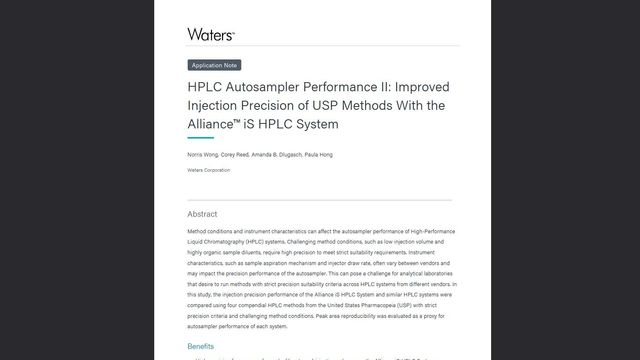
HPLC Autosampler Performance II: Improved Injection Precision of USP Methods With the Alliance™ iS HPLC System
The injection precision performance of the Alliance iS HPLC System and similar HPLC systems were compared using four compendial HPLC methods from the United States Pharmacopeia (USP). (Part 2 of 2)
App Note / Case Study
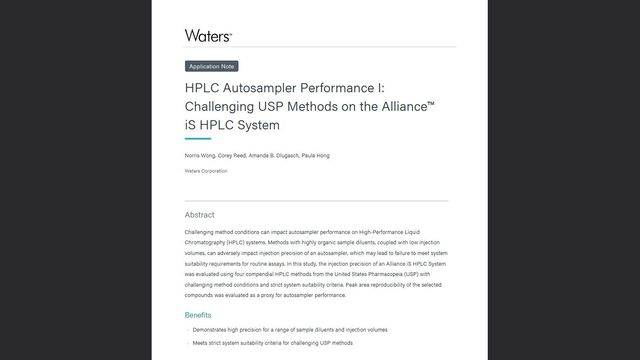
HPLC Autosampler Performance I: Challenging USP Methods on the Alliance™ iS HPLC System
The injection precision performance of the Alliance iS HPLC System and similar HPLC systems were compared using four compendial HPLC methods from the United States Pharmacopeia (USP). (Part 1 of 2)
App Note / Case Study
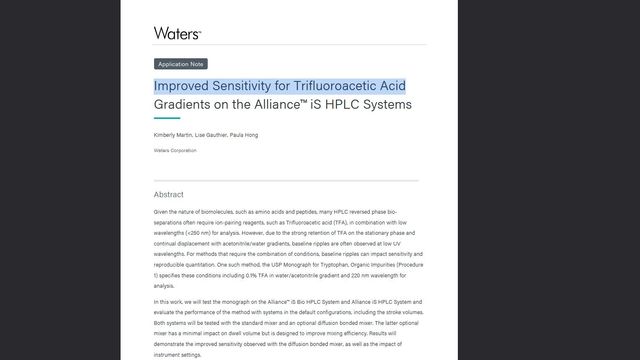
Improved Sensitivity for Trifluoroacetic Acid Gradients on the Alliance™ iS HPLC Systems
While testing the monograph on the Alliance™ iS Bio HPLC System and Alliance iS HPLC System, we observed improved sensitivity with the diffusion bonded mixer, as well as the impact of instrument settings
App Note / Case Study
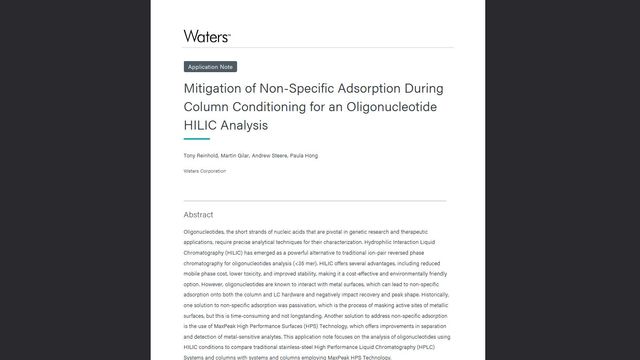
Mitigation of Non-Specific Adsorption During Column Conditioning for an Oligonucleotide HILIC Analysis
This app note focuses on the analysis of oligonucleotides using HILIC conditions to compare traditional stainless-steel High Performance Liquid Chromatography (HPLC) Systems and columns with systems and columns employing MaxPeak HPS Technology
App Note / Case Study
Method Migration of a Reversed Phase TFA-Acetonitrile Gradient Method From a Binary to a Quaternary System: Impact of Mixing
On the Alliance iS HPLC System, the optional 690 µL Ti diffusion bonded mixer improved baselines, enabled more reproducible peak integration, and increased sensitivity compared to that of the binary and the quaternary systems with standard mixers
App Note / Case Study
Spectral Analysis of Broad-Spectrum Sunscreens Using the Alliance™ iS HPLC System With Photodiode Array (PDA) Detector
The Alliance iS HPLC System with Photodiode Array (PDA) Detector separates and identifies compounds, determines spectral purity, and visualizes UV absorptive regions for chemical UV filters used in sunscreen lotion formulations.
App Note / Case Study
Modernization of a Legacy Normal-Phase HPLC Method
In this study, the United States Pharmacopeia (USP) propofol assay normal-phase method was successfully modernized on the Alliance™ iS HPLC PDA System using a modern column.
App Note / Case Study
Optimization of Detector Parameters to Improve Sensitivity Using the Alliance™ iS HPLC System With PDA Detector
In this study, the USP method for organic impurities in ibuprofen tablets was used to demonstrate how optimizing detector settings produced an improvement in sensitivity.
App Note / Case Study
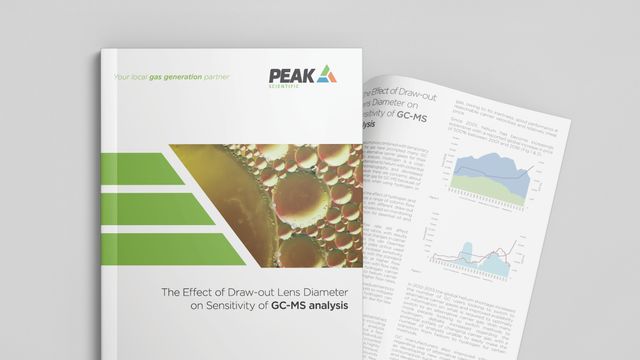
Optimize GC-MS Sensitivity With Lens Adjustment
This app note explores how switching the draw-out lens impacts sensitivity and resolution with hydrogen versus helium, across various flow rates and detection modes.
App Note / Case Study
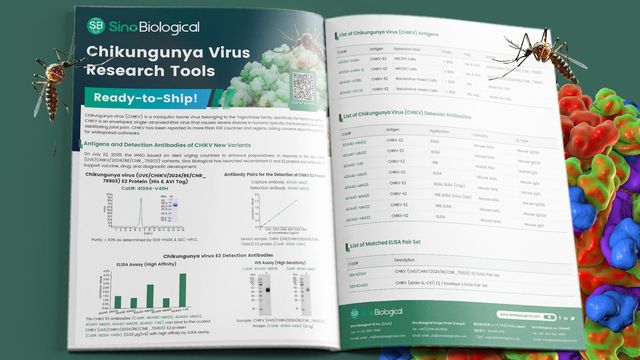
Chikungunya Virus Research Tools
In response to the new CHIKV variants, Sino Biological quickly launched recombinant E1 and E2 proteins, as well as antibodies, to support researchers in the development of vaccines, antiviral drugs, and immunodiagnostic assays
Advertisement