Latest App Notes & Case Studies
App Note / Case Study
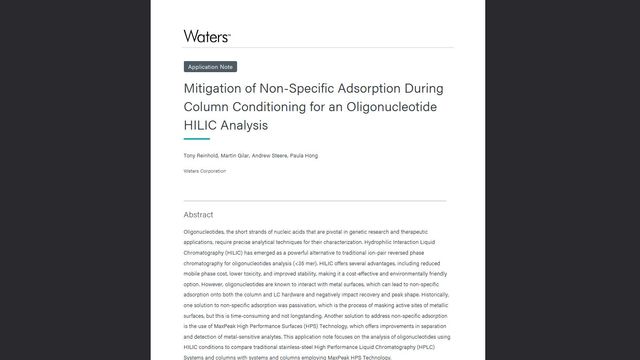
Mitigation of Non-Specific Adsorption During Column Conditioning for an Oligonucleotide HILIC Analysis
This app note focuses on the analysis of oligonucleotides using HILIC conditions to compare traditional stainless-steel High Performance Liquid Chromatography (HPLC) Systems and columns with systems and columns employing MaxPeak HPS Technology
App Note / Case Study
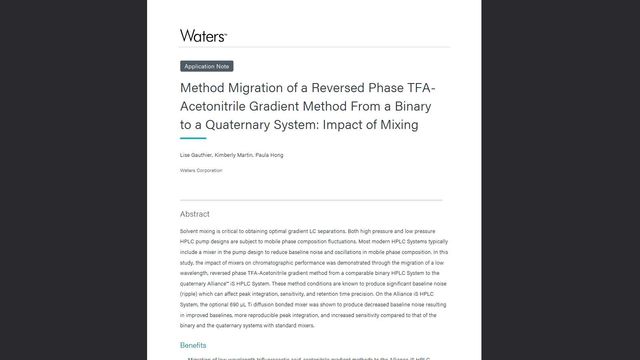
Method Migration of a Reversed Phase TFA-Acetonitrile Gradient Method From a Binary to a Quaternary System: Impact of Mixing
On the Alliance iS HPLC System, the optional 690 µL Ti diffusion bonded mixer improved baselines, enabled more reproducible peak integration, and increased sensitivity compared to that of the binary and the quaternary systems with standard mixers
App Note / Case Study
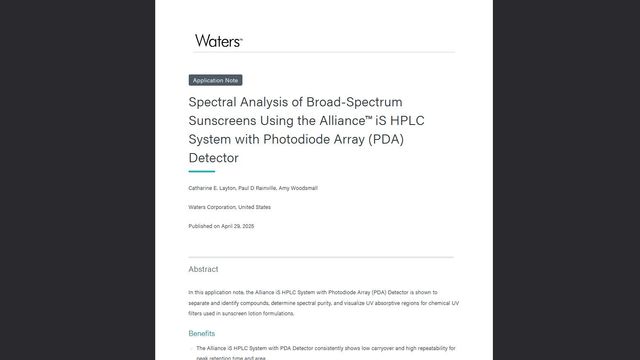
Spectral Analysis of Broad-Spectrum Sunscreens Using the Alliance™ iS HPLC System With Photodiode Array (PDA) Detector
The Alliance iS HPLC System with Photodiode Array (PDA) Detector separates and identifies compounds, determines spectral purity, and visualizes UV absorptive regions for chemical UV filters used in sunscreen lotion formulations.
App Note / Case Study
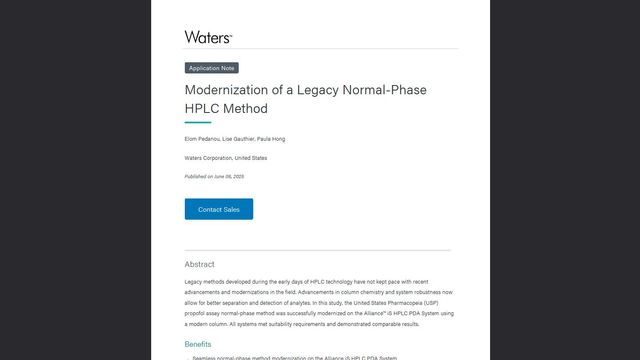
Modernization of a Legacy Normal-Phase HPLC Method
In this study, the United States Pharmacopeia (USP) propofol assay normal-phase method was successfully modernized on the Alliance™ iS HPLC PDA System using a modern column.
App Note / Case Study
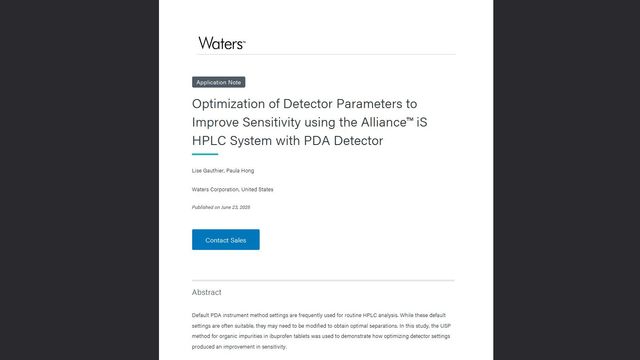
Optimization of Detector Parameters to Improve Sensitivity Using the Alliance™ iS HPLC System With PDA Detector
In this study, the USP method for organic impurities in ibuprofen tablets was used to demonstrate how optimizing detector settings produced an improvement in sensitivity.
App Note / Case Study
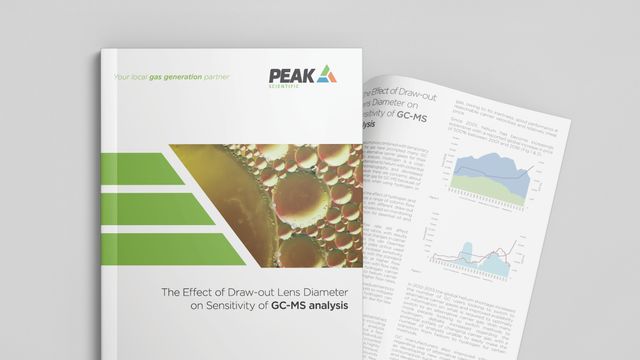
Optimize GC-MS Sensitivity With Lens Adjustment
This app note explores how switching the draw-out lens impacts sensitivity and resolution with hydrogen versus helium, across various flow rates and detection modes.

App Note / Case Study
Trace-Level Detection of Nitazenes in Dried Blood Spot Samples
This application note highlights a complete extraction-to-analysis method that offers the exceptional sensitivity and robust quantitation needed to analyze nine nitazene analogs and brorphine in DBS samples.
App Note / Case Study
Extractables and Leachables Analysis: PFAS Screening in the Pharmaceutical Industry
Proactive detection and risk mitigation are essential to ensure product safety and compliance with future regulations. This app note showcases a comprehensive screening solution that can ensure targeted and accurate PFAS screening.

App Note / Case Study
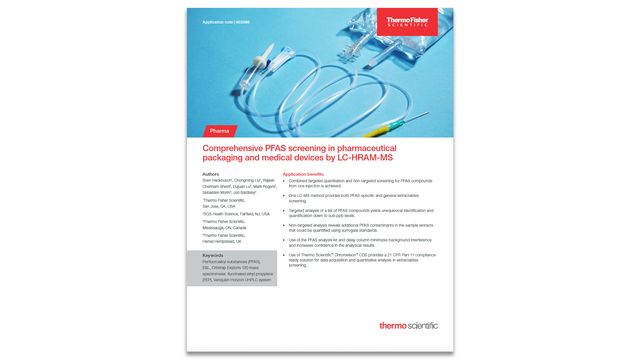
Comprehensive PFAS Screening in Pharmaceutical Packaging and Medical Devices
This application note assesses an LC-MS strategy for testing manufacturing components for PFAS, even at sub-ppb levels, ensuring reliable results.

App Note / Case Study
How To Detect Trace Metals During Semiconductor Manufacturing
This application note demonstrates how advanced multi-quadrupole ICP-MS technology can revolutionize ultra-pure NMP analysis for effective semiconductor manufacturing quality control.
Advertisement